

CISA flags exploited Check Point, UnrealIRCd and Barracuda flaws as patch deadlines arrive
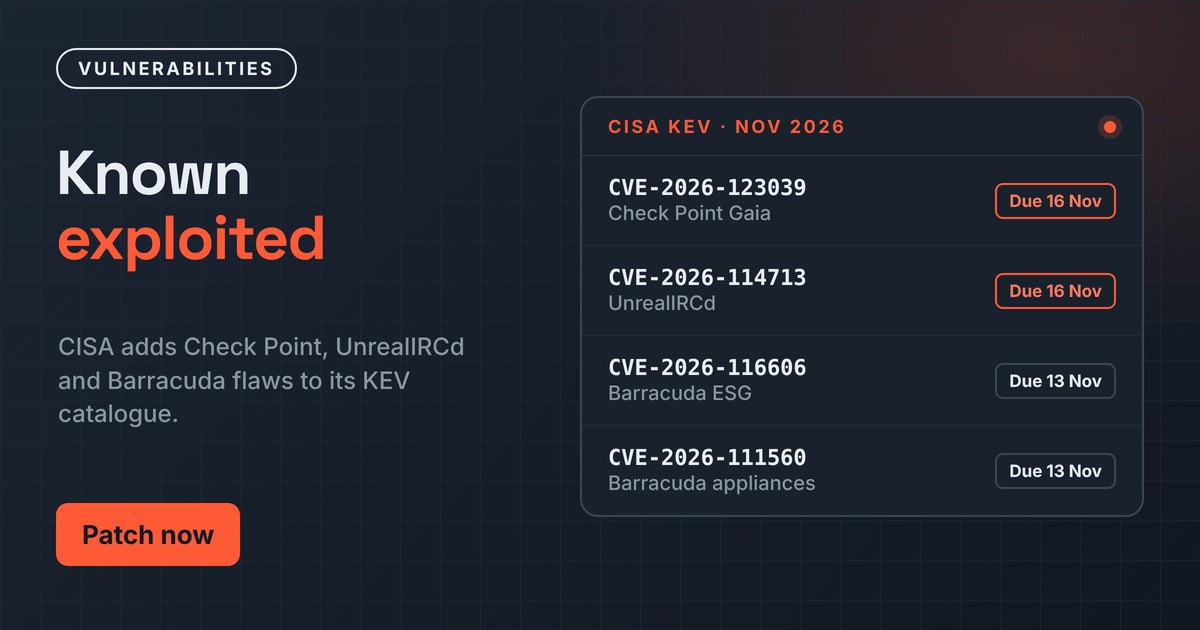
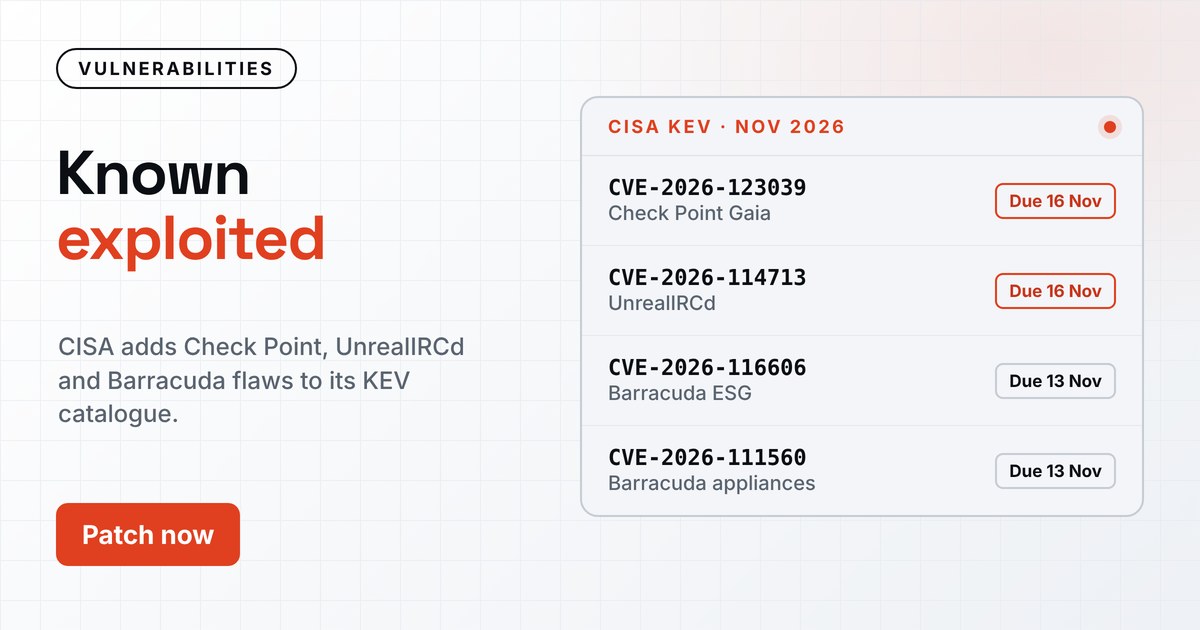
On 13 November the US Cybersecurity and Infrastructure Security Agency (CISA) added two more flaws to its Known Exploited Vulnerabilities (KEV) catalogue, based on evidence of active exploitation: a privilege escalation in Check Point’s Gaia operating system and a command injection in the UnrealIRCd chat server. Three days earlier it had added two flaws in Barracuda’s Email Security Gateway (ESG) that can be chained to take full control of the appliance.
US federal agencies must fix the Check Point and UnrealIRCd flaws by 16 November. The Barracuda deadline, 13 November, has already passed. In total, CISA added 12 entries to the KEV catalogue between 9 and 15 November.
| CVE | Product | What it allows | Severity | Added | US deadline |
|---|---|---|---|---|---|
| CVE-2026-123039 | Check Point Gaia | Local user to root | 7.8 High | 13 Nov | 16 Nov |
| CVE-2026-114713 | UnrealIRCd | Ordinary user to server authority | High | 13 Nov | 16 Nov |
| CVE-2026-116606 | Barracuda ESG | Authentication bypass | 9.3 Critical | 10 Nov | 13 Nov |
| CVE-2026-111560 | Barracuda appliances | OS command injection as root | 8.6 High | 10 Nov | 13 Nov |
Check Point Gaia: from web portal to firewall root
CVE-2026-123039 is a flaw in the DynamicCLI process on Check Point’s Gaia operating system. According to Check Point’s advisory, the process runs as root and listens on a local control socket that any user can write to, so anyone who can already run code on the appliance can escalate to root. Check Point says it has seen the flaw exploited “against a couple of dozen customers”. It affects Gaia versions R81 to R82.20 on Check Point’s firewalls, management and log servers, Multi-Domain servers and Maestro Orchestrator.
On its own the flaw needs a foothold. Check Point’s research team describes how attackers got one:
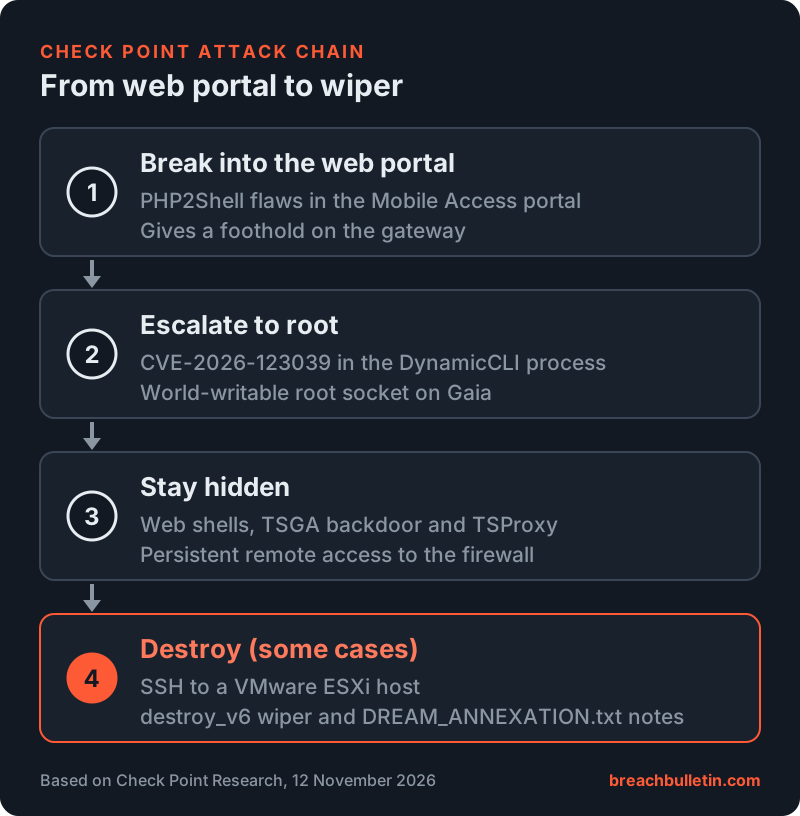
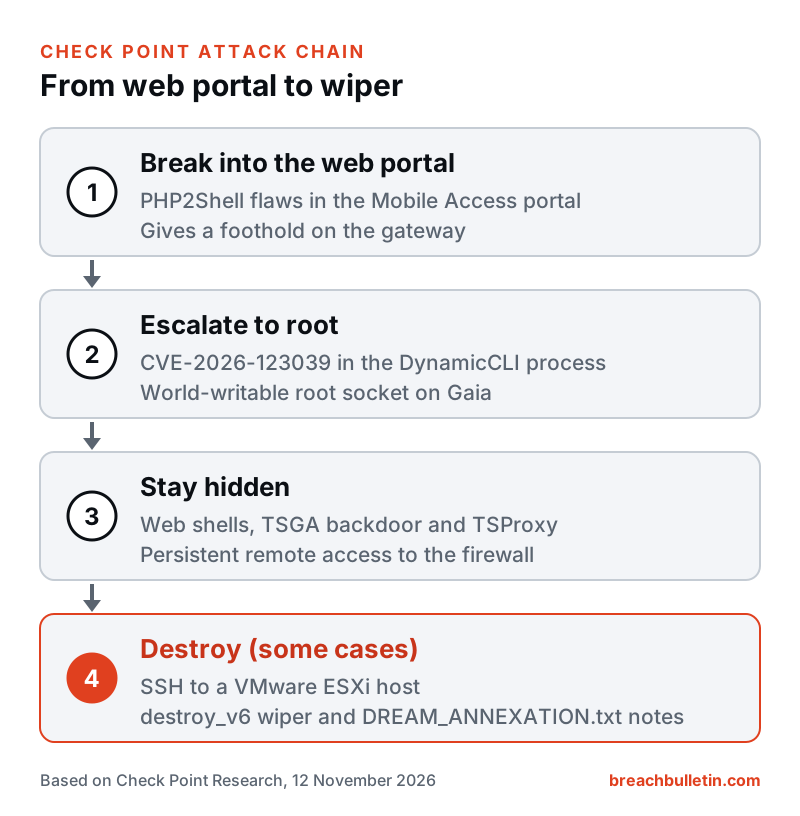
- Initial access came through PHP2Shell flaws in the Mobile Access web portal on Check Point gateways.
- Root access followed through CVE-2026-123039.
- Persistence came from web shells and a backdoor called TSGA, with a networking component called TSProxy.
- Destruction followed in some cases. The attackers moved over SSH from the gateway to a VMware ESXi host, ran a wiper called destroy_v6 and left politically themed notes named DREAM_ANNEXATION.txt.
A first wave on 30 October targeted Israeli organisations, some of which suffered destructive attacks. A broader second wave on 2 November hit organisations in several countries and sectors, with no destruction seen. Check Point says TSGA and TSProxy are modified versions of a malware framework previously seen in attacks on Ivanti products, but it does not attribute the campaign to a specific group with high confidence.
UnrealIRCd: any user can act as the server
UnrealIRCd is widely used open-source software for running IRC chat networks. CVE-2026-114713 is an escaping flaw in how it handles an IRCv3 message tag called “label”. By injecting new lines and other characters, an ordinary user can send commands that the network treats as coming from a server, with full operator authority. That means disconnecting and banning other users, and much more.
The project’s maintainer called it the most critical issue found in UnrealIRCd in 15 years, and later updated the post to say attackers are exploiting it in the wild. It was found during an internal audit, with the help of AI, alongside eight lower-severity issues. Version 6.2.7.1, released on 7 November, fixes it, and a hot-patch is available for 6.0.0 to 6.2.7 that does not need a restart. Severity scores vary: some sources rate it 8.6, while NVD scores it 7.7.
Barracuda ESG: no login needed for root
Barracuda’s advisory covers two flaws that combine into a full takeover:
- CVE-2026-116606 (CVSS 9.3) lets an attacker bypass authentication on the ESG’s administrative interface. No login is needed, only access to the admin interface.
- CVE-2026-111560 (CVSS 8.6) is an OS command injection in a timezone setting, shared across several Barracuda products.
Chained together, they give an attacker root on the appliance. Barracuda updated its advisory on 9 November to say it has identified exploitation affecting a small number of organisations. The command-injection flaw also affects other Barracuda products, including its Load Balancer ADC, Web Application Firewall, Web Security Gateway, Message Archiver and WAF Control Center.
Edge devices, again
Firewalls, VPN portals, email gateways and chat servers all face the internet, and attackers keep going after them for that reason. In the Check Point campaign, one exposed web portal gave the attackers a path to root on the firewall, and in some cases on to wiping servers deeper inside the network.
What to patch first
- Check Point: install the latest Jumbo Hotfix for your Gaia version, as listed in sk1000362. If you can’t patch straight away, Check Point’s advisory explains how to stop the DynamicCLI process as a temporary measure. Make sure your Mobile Access portal is also patched against PHP2Shell, and review its logs and the gateway for signs of web shells or the TSGA backdoor.
- UnrealIRCd: upgrade every server to 6.2.7.1, or apply the hot-patch described in the maintainer’s announcement. Until then, the announcement includes a spamfilter workaround.
- Barracuda: apply Barracuda’s patches for the ESG and any other affected products listed in its advisory, and restrict the administrative interface to trusted networks. Beazley Security notes that ESG version 9.4.0.030 or later includes both fixes.
- Everyone else: use the KEV catalogue as a priority list. You don’t have to be a US federal agency for it to apply, since a listing means attackers are already using the flaw.