

Nvidia heads into Q3 results under interim CEO Colette Kress
Nvidia, the company whose chips power most of today’s AI infrastructure, will report its fiscal third-quarter results on Tuesday 17 November with an interim chief executive in charge. They are its first results since founder Jensen Huang stepped down, and investors want to hear about leadership as much as the numbers.
What happened
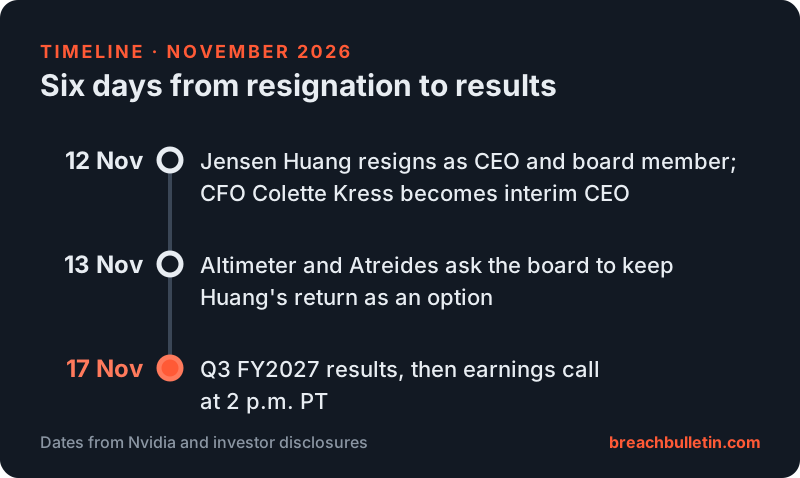
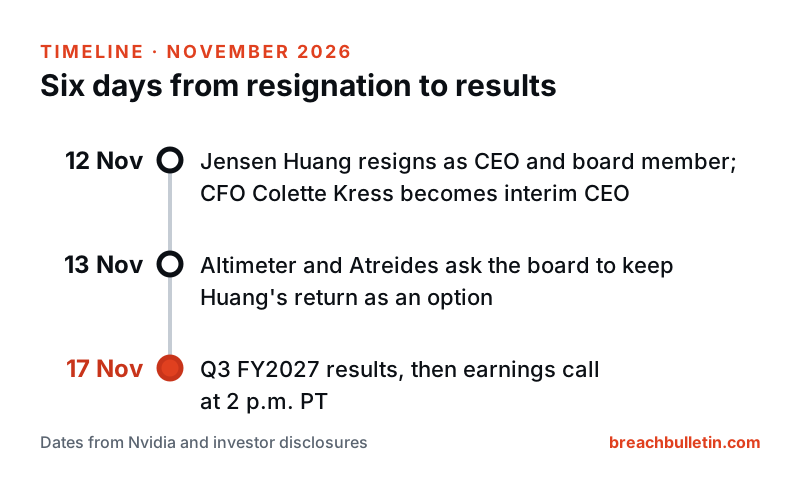
On 12 November, Nvidia announced that Huang had resigned as president, chief executive and board member, effective immediately. Chief financial officer Colette Kress became interim CEO and keeps her CFO role until a permanent successor is named. The board said it will consider internal and external candidates, and named Harvey C. Jones as Nvidia’s first board chair. Nvidia’s announcement did not give a reason for Huang’s departure.
Investors ask the board not to rush
Two of Nvidia’s best-known shareholders, Altimeter Capital and Atreides Management, wrote to the board on Friday 13 November. Altimeter’s Brad Gerstner and Atreides’ Gavin Baker asked it to take a deliberate approach to choosing the company’s next leader and to keep Huang’s potential return among the options.
They stopped short of demanding his reinstatement. According to their letter, they accept that the final decision rests with the board once all the facts are known. Together the two funds hold about 10.6 million Nvidia shares, based on their latest SEC filings.
What to watch on Tuesday
Nvidia will publish its results at about 1:20 p.m. Pacific time on 17 November, followed by an earnings call at 2 p.m. The date was set before the leadership change. Things to listen for:
- Any update on the CEO search, and how Kress describes doing both jobs.
- Guidance on how much AI hardware Nvidia can ship in the coming quarters, which shapes data-centre build-outs across the industry.
- How much of the outlook depends on sales to China affected by US export rules.
- Whether timelines for its next AI chips have changed.
Why security teams should care
Security teams have nothing to do here. Nvidia’s chips do sit underneath most of the AI services organisations use, though, including many security tools. If Nvidia’s supply or chip roadmap slips, cloud AI capacity and the products built on it feel it next. Tuesday’s call will be the first sign of whether that has happened.