

Apache Roller flaw under attack lets anyone run code on blog servers
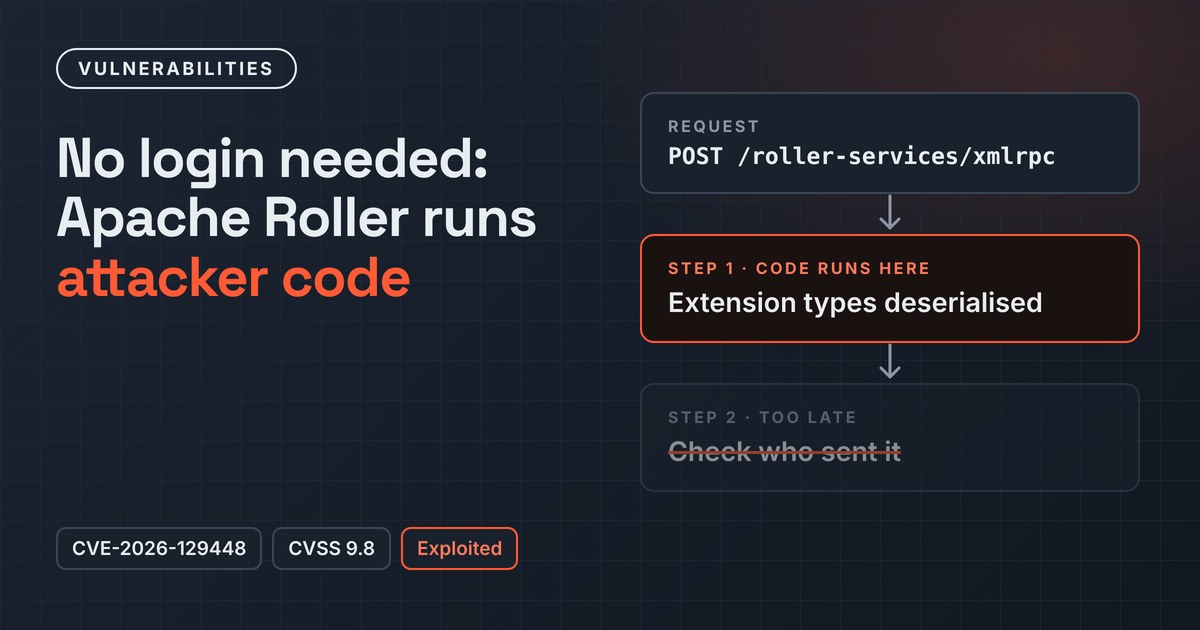
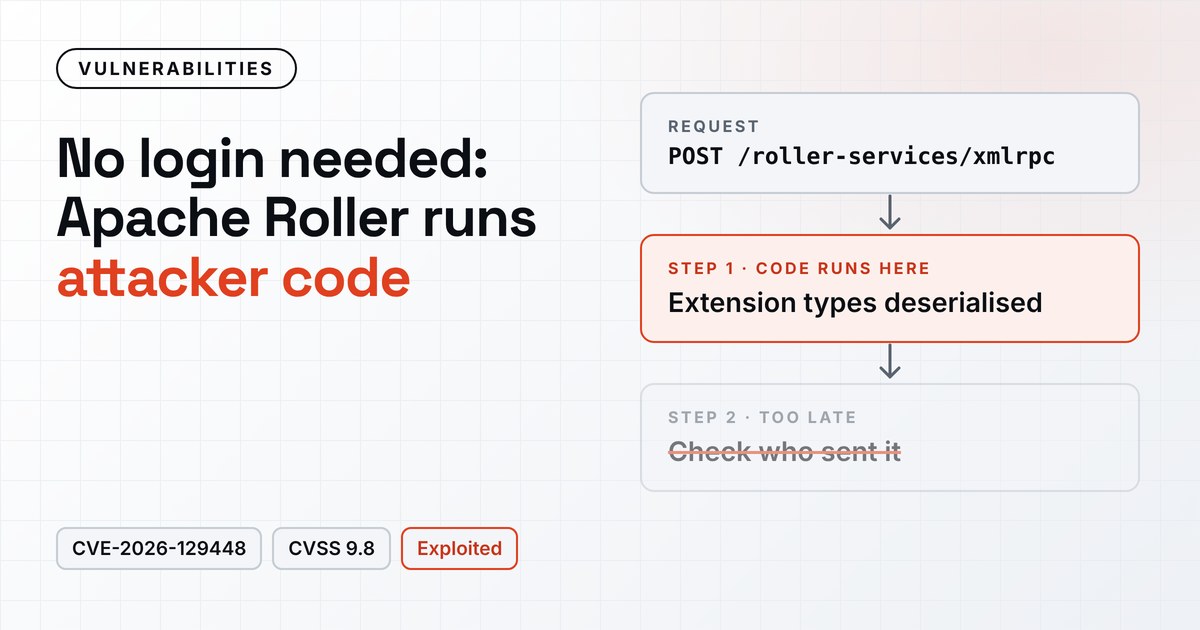
Apache is warning that attackers are exploiting a critical flaw in Apache Roller, the open-source Java blog server. The flaw, CVE-2026-129448, lets anyone who can reach a Roller site run code on the server without logging in. “This issue is being actively exploited,” Apache says in the CVE record it published on 17 November. It rates the flaw 9.8 out of 10.
What the flaw is
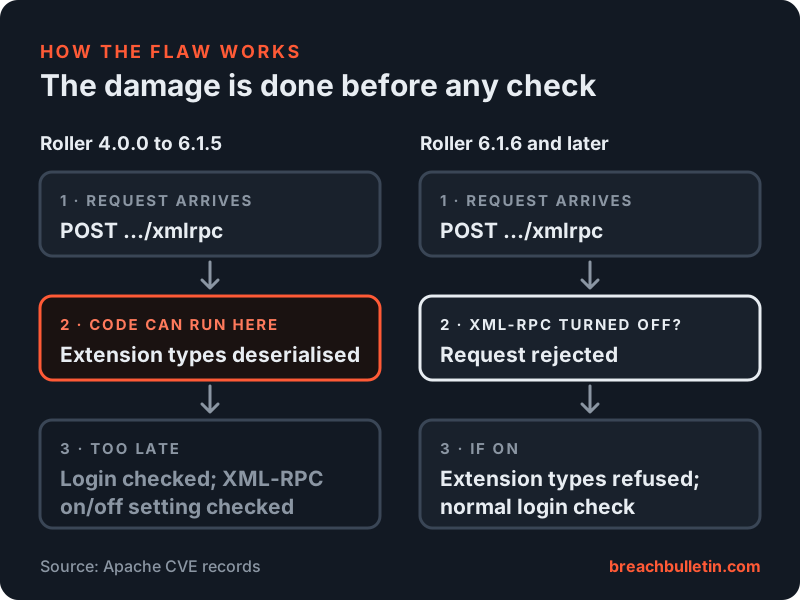
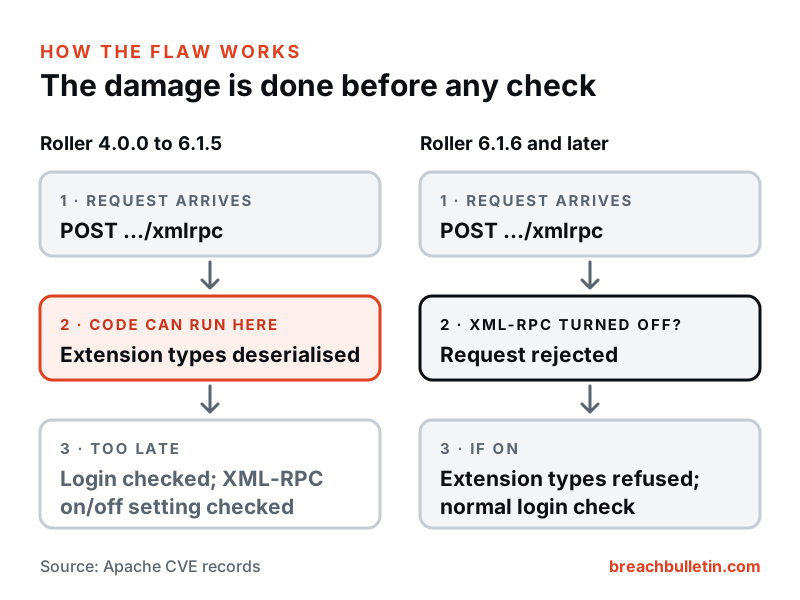
Roller has an XML-RPC endpoint, /roller-services/xmlrpc, which blog-editing
apps use to publish posts remotely. According to Apache, the endpoint accepts
“vendor extension types”, which are Java objects packed into the request, and
deserialises them before it checks who sent the request. Turning
attacker-supplied data back into Java objects is a well-known route to running
code on the server.
Switching XML-RPC off in Roller’s admin panel does not help on vulnerable versions. Apache’s original advisory explains that the endpoint is always active, so the request is unpacked even when the feature is turned off. The on/off setting is only checked afterwards.
One bug, two CVE numbers
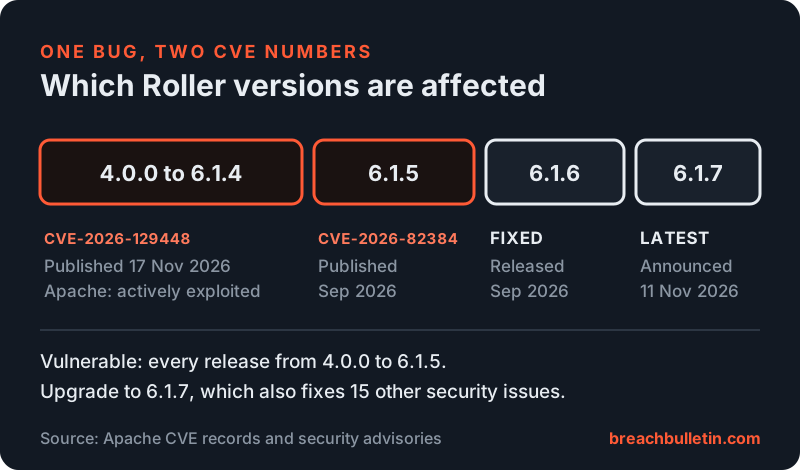
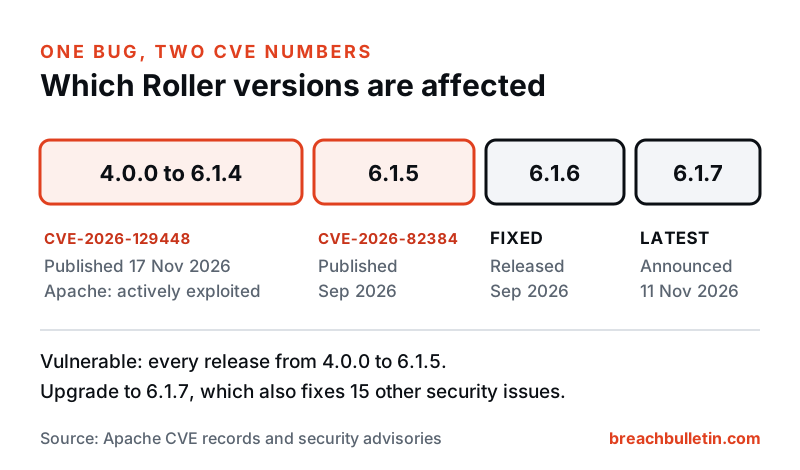
Apache first disclosed this bug in September as CVE-2026-82384, but listed only Roller 6.1.5 as affected. The new record says the same flaw reaches back to version 4.0.0, and adds the warning that it is being exploited. Vulnerability scanners and asset inventories that relied on the first record may have reported older Roller servers as safe.
Some reports say 6.1.5 fixes the flaw, but 6.1.5 is vulnerable. The new record’s title mentions “releases before 6.1.5” because it covers only versions 4.0.0 to 6.1.4. Version 6.1.5 is covered by the September record. Apache says users should upgrade to 6.1.6 or later.
Go straight to 6.1.7
Version 6.1.6 closes this flaw. Its fix stops accepting the extension types and rejects XML-RPC requests when the feature is turned off. But the current release is 6.1.7, which Apache announced on 11 November with fixes for 15 more security issues. They include a second unsafe deserialisation flaw, in how Roller reads replies from the sites it pings (CVE-2026-123374), and an XML external entity flaw in its AtomPub interface (CVE-2026-105153). Apache has not said either of those is being exploited.
The 6.1.7 release notes list several behaviour changes, such as stricter rules for custom themes, so read them before you upgrade a customised site.
What we don’t know yet
Apache has not shared any details of the attacks, or indicators that would help defenders spot them, so it’s unclear who is exploiting the flaw or how widely.
As of 17 November, the flaw is not in CISA’s Known Exploited Vulnerabilities catalogue. CISA’s initial automated assessment, added to the CVE record when it was published, recorded no known exploitation, so for now Apache’s statement is the only public confirmation. Our recent KEV round-up explains what a listing means.
Old blogs, easy targets
Roller has been around for more than 20 years. Plenty of the corporate and community blogs running it were set up long ago and rarely get looked at, so they are easy to miss when patching. If one of those servers is on the internet and runs attacker code, the attacker has a way into the network behind it.
This flaw needs no login and works on default settings. Attackers are also moving faster from fix to exploit: Google’s threat intelligence team recently reported attackers using AI tools to turn new patches into working exploits automatically.
Steps for Roller admins
-
Find every Roller server, including old blogs, test copies and internal sites. Requests to the
/roller-services/xmlrpcpath are a quick way to spot them. -
Upgrade to 6.1.7 from the Roller download page, or at least to 6.1.6.
-
If you can’t upgrade straight away, do one of the following, as set out in Apache’s CVE record, and then restart Roller:
- set
enabledForExtensionstofalseinWEB-INF/web.xml, or - remove the
/roller-services/xmlrpcservlet mapping.
Turning XML-RPC off in the admin panel won’t protect you.
- set
-
If no one publishes to your blog from a desktop or mobile app, block requests to
/roller-services/xmlrpcat your reverse proxy or web application firewall. -
Look for signs of compromise. Review web server logs for POST requests to
/roller-services/xmlrpc, especially from unfamiliar addresses, and check the server for unexpected files and for processes started by the application server’s user. If a vulnerable server was exposed to the internet, treat it as possibly compromised: investigate it, and rotate the database password and any other secrets in its configuration.