

Barracuda: an AI attack framework and a forgotten vendor key opened its cloud for 44 hours
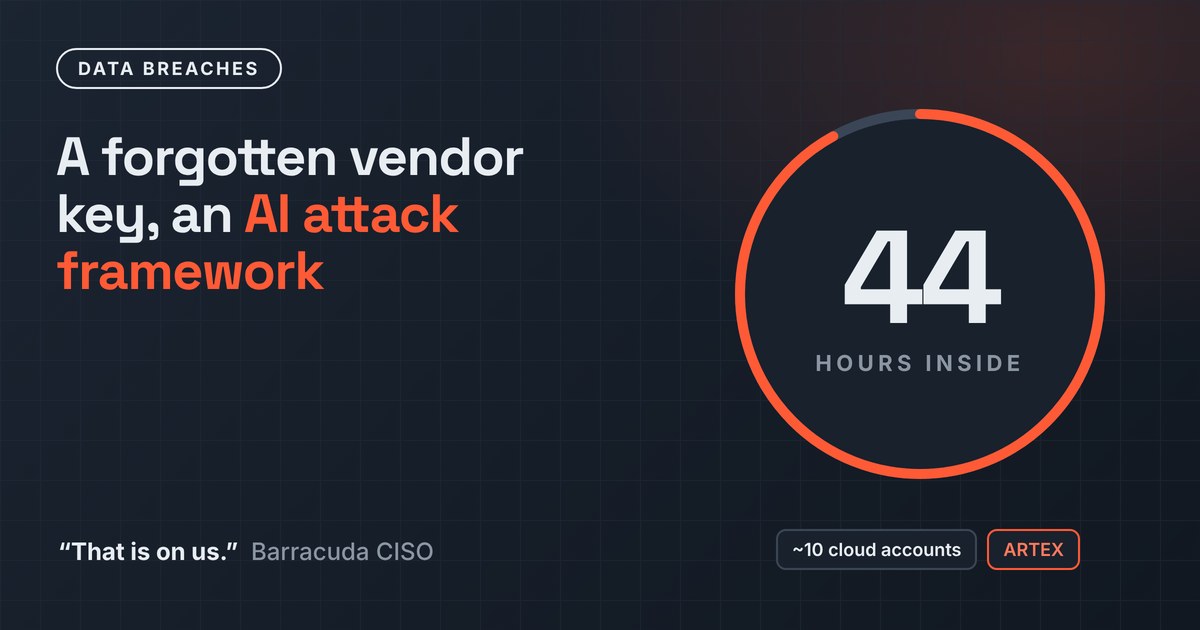
Barracuda has disclosed how an attacker spent 44 hours inside its cloud environment, and it has been candid about why. The way in was a cloud access key Barracuda had given to an outside AI company for a past project and never switched off. “That is on us,” Chief Information Security Officer Arve Kjoelen wrote.
Barracuda says the attacker’s tooling matches ARTEX, one of the AI attack frameworks that Google’s threat intelligence team flagged in its latest report.
How it happened
According to Barracuda’s write-up and its security advisory:
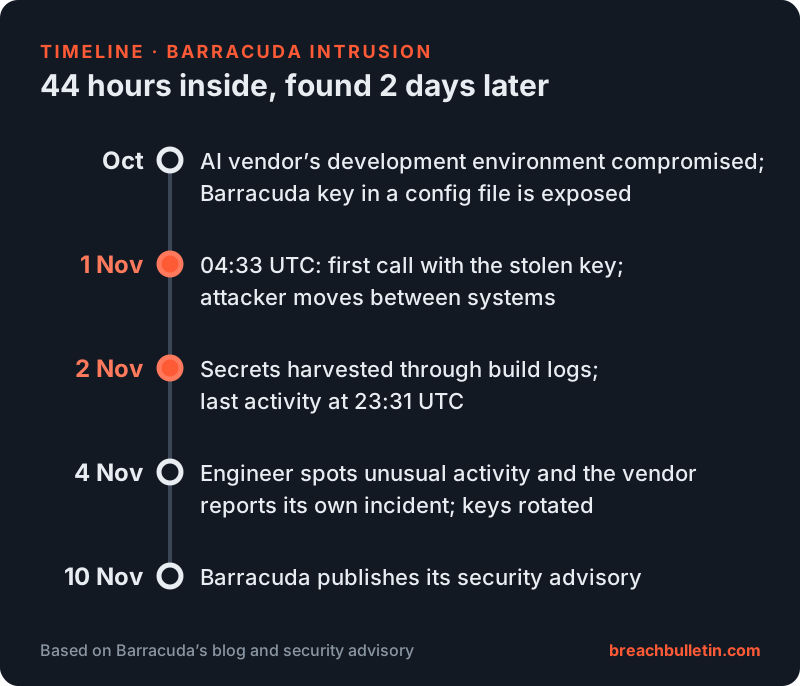
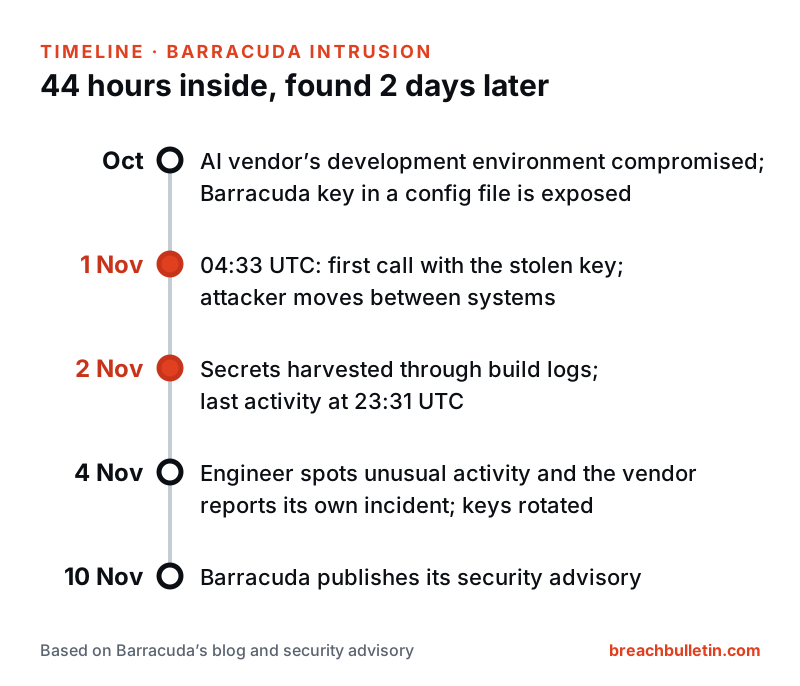
- October: the vendor’s development environment was compromised. The Barracuda key was stored in a configuration file in the vendor’s GitHub repository, and appears to have been taken from there. Barracuda describes the vendor only as “a company working in AI” and has not named it.
- 1 November, 04:33 UTC: the attacker made its first call using the key, then used secrets it found to move from system to system.
- 2 November: over about four hours, it pushed short-lived code branches to trigger a build workflow that printed secrets into job logs, encoding them to get past log masking. Its last recorded activity was at 23:31 UTC.
- 4 November: a Barracuda engineer spotted unusual activity on their own account and reported it. The same day, the vendor contacted Barracuda about its own incident. By then the attacker had already stopped. Barracuda removed a backdoor container that evening and began rotating credentials.
In total the attacker touched about 10 cloud accounts. It read stored secrets, reached a data analytics system, used it to get a source-code access token, and from there reached Kubernetes clusters. It deployed a container that mounted the underlying server’s file system to collect more credentials, and tried to create a new cloud administrator identity for itself, which was blocked.
What the attacker was after
On servers it reached, the attacker searched for cryptocurrency wallets, seed phrases and private keys, which Barracuda says points to a financial motive. It found none. Because some of the secrets within reach were credentials for AI services, Barracuda says it cannot rule out that the attacker also wanted those.
Why Barracuda points to ARTEX
ARTEX is an open-source, AI-driven penetration-testing framework released in July 2026. A “planner” agent decides what to do next and “worker” agents run common hacking tools. Barracuda says the probe names, other indicators, the order of the attacker’s work and its built-in routines for hunting credentials and wallets all match ARTEX. Because many groups use the framework, it stresses that this shows how the attacker worked, not who they were.
The disclosure lands in the same week as an FBI FLASH alert on ARTEX. The FBI says a range of attackers have used it since at least August 2026, with some intrusions going from first targeting to privileged access in under three hours. It also warns that attackers single out weaker third-party vendors as a way in. The original ARTEX repository was taken down in October, but copies and a commercial version remain available.
What it means for Barracuda customers
One system the attacker reached stores the credentials Barracuda XDR uses to collect data from customers’ connected services, such as Microsoft 365 and Google Workspace. Barracuda says it found “no direct evidence” those credentials were viewed, but its logging could not rule it out, so it is treating them as exposed.
Only customers using an API integration for Barracuda Managed XDR Cloud or Monitored Endpoint are affected, and Barracuda has contacted them directly. If you have not been notified, Barracuda says no action is needed.
This incident is separate from the exploited Barracuda Email Security Gateway flaws added to CISA’s KEV catalogue on 10 November.
A familiar pattern
This is the second time in a week that a key held by an AI vendor has become someone else’s way in. Cursor said its attacker started with a key it had issued to Fireworks AI, as we reported in Breaches at AI suppliers are now hitting their customers. Barracuda has not said which AI company it was working with, so there is no evidence the two incidents involve the same vendor. In both cases, though, access handed to a supplier for one project was still live long after the project ended.
What to check
- Affected Barracuda customers: if you were notified, revoke and recreate your Managed XDR Cloud or Monitored Endpoint integration credentials, and review activity in the connected systems since 1 November. Barracuda’s advisory lists IP addresses and user agents to check.
- List every key you have given a vendor, including cloud access keys, API tokens and service accounts held by AI, data and analytics partners. Revoke the ones they no longer need.
- Where vendors do need access, give them short-lived, narrowly scoped credentials that expire when the work ends.
- Scan code repositories, build pipelines, container images and logs for exposed secrets, including repositories you share with vendors, and rotate anything you find.
- Make sure a new branch can’t trigger a build workflow that prints secrets, and limit who can push to repositories that run those workflows.