

Google: attackers have started fully automating exploitation with AI agents
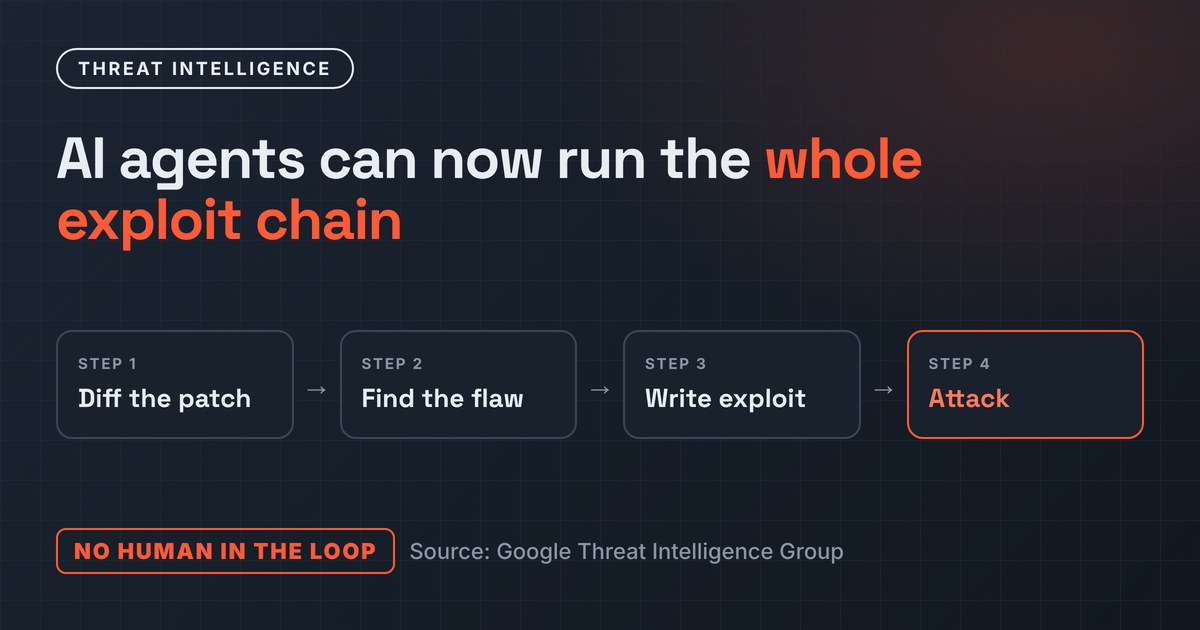
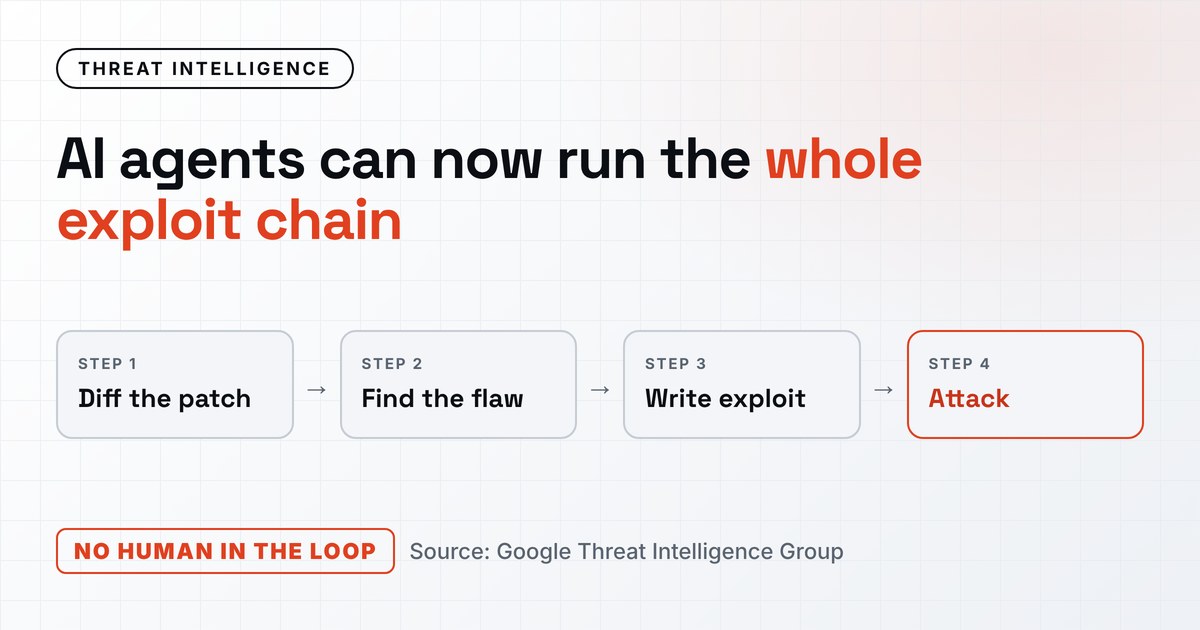
Google’s Threat Intelligence Group (GTIG) says attackers have reached a point defenders have been expecting. In its latest AI Threat Tracker, published on 16 November, GTIG reports that in the past quarter it saw threat actors using AI frameworks to “fully automate vulnerability discovery and exploitation without a human in the loop for the first time”.
Fully automated attacks are still rare. GTIG’s own timeline puts most current activity at several attack stages run by AI tools with “minimal” human involvement, and it expects that to change within months.
The first fully automated pipeline
The clearest example came from an exposed staging server. On it, GTIG found a multi-agent framework it calls exploit_agent, which works with several commercial and locally run AI models. It continuously compares popular web application software before and after security patches are announced, identifies the flaws those patches fix, drafts exploits for them and then runs them, all without human intervention.
The server also held data taken from victims and scripts for follow-up activity, including internal reconnaissance, password brute-forcing, installing web shells and removing other attackers’ web shells. Data on the server suggests its operator was targeting French websites in the media, entertainment and education sectors.
A tool like this shrinks the time between a patch coming out and attackers using an exploit against anyone who hasn’t installed it.
Off-the-shelf attack frameworks
GTIG also tracks a growing set of AI “agentic” frameworks that string together the stages of an intrusion, several of them open source:
- CAIRN, a multi-agent penetration-testing framework in which specialised agents work towards a goal from a starting point such as an IP address. GTIG saw it used in intrusions against targets including the US aerospace sector.
- PentAGI, an open-source framework aimed at less skilled operators. Between late August and early October 2026, a threat actor used a customised version to carry out systematic reconnaissance and vulnerability scanning against a wide range of organisations in Asia.
- CyberStrikeAI and HexStrike AI, which connect AI models to large sets of security tools. GTIG has seen attackers experimenting with both.
- ARTEX, which GTIG covers in a separate report. Google says its Security Operations (SecOps) platform now has dedicated detection rules for it.
GTIG says financially motivated actors and suspected China-nexus espionage groups are among those experimenting with these tools.
AI coding tools as an attack path
The report also shows attackers abusing the AI tools organisations already use. A suspected North Korea-linked cluster that GTIG tracks as MIDNIGHT NEPTUNE targeted cryptocurrency companies in North America and Europe:
- It created fake recruiter profiles, with profile images that carried Google’s SynthID watermark, showing they were AI-generated.
- It sent targets to fake meeting sites with “ClickFix” lures that tricked them into running malicious scripts.
- Once inside, it edited the Claude Code settings file
(
.claude/settings.json) in the company’s internal code repositories, so that the SOMBERMEME backdoor downloaded automatically whenever a developer started Claude Code. - It also created GitHub access tokens named after Microsoft Copilot to blend in while moving through the network.
Claude Code itself had no flaw here. The attackers changed its configuration inside repositories they had already compromised, and used a tool developers trusted to spread further.
In separate research, Darktrace showed a related risk. In a lab demonstration published on 12 November, its researchers used the “memory stores” feature of Anthropic’s Claude platform as a hidden command-and-control channel, sending instructions to Claude Code agents inside a simulated company network and reading back their results. It only works once an attacker has already compromised a device and stolen the user’s Claude credentials, and Darktrace says it does not rely on a vulnerability in the platform.
What comes next
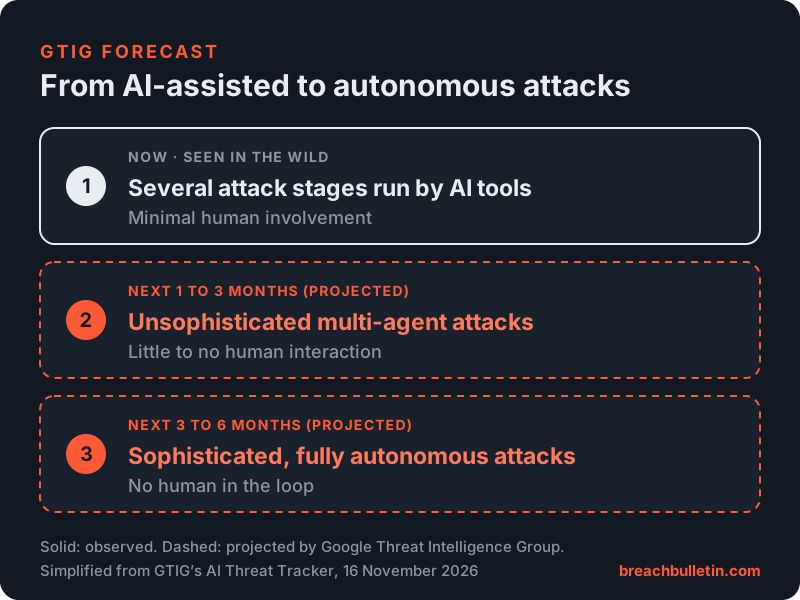
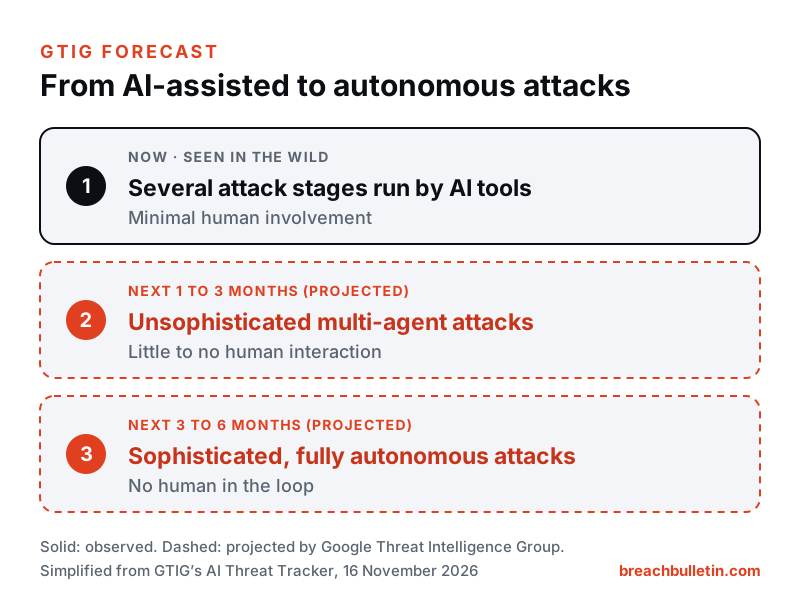
GTIG’s timeline sets out where it expects this to go. The current stage, seen in the wild, is several stages of an attack run by AI tools with minimal human involvement. Within one to three months, it projects multi-agent attacks that are unsophisticated but run with little to no human interaction. Within three to six months, it expects sophisticated, fully autonomous attacks.
GTIG is forecasting here, and hasn’t observed these later stages yet. Few teams see as much attacker activity as Google’s, though.
How to prepare
- Shorten patch timelines for anything exposed to the internet, starting with web applications and their plugins. Tools like exploit_agent exist to turn new patches into working exploits.
- Handle AI API keys and agent credentials like any other privileged secret. Keep them in a secrets manager, scope them tightly, rotate them and watch for use from unusual places. GTIG notes that attackers also make money from “LLMjacking”, stealing AI credentials and running up usage on victims’ accounts.
- Review changes to files such as
.claude/settings.jsonand other agent hooks as carefully as changes to build scripts, and require code-owner approval for them. - Monitor AI agent processes for unexpected network connections, new child processes and unusual volumes of data sent to AI services.
- Warn developers and finance teams about fake recruiters and ClickFix lures, and tell them not to run “fix” commands from meeting or recruitment sites.
- Google SecOps customers: make sure the ARTEX detection rules are enabled.