

Optimizely supply-chain attack served malware to visitors of 178 major websites
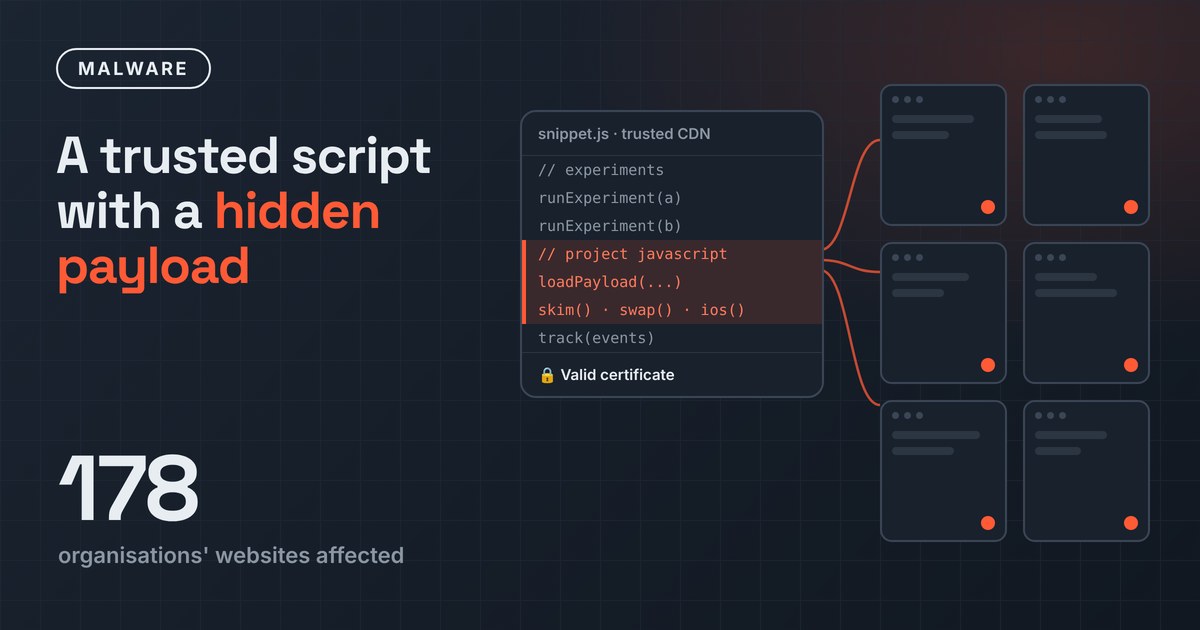
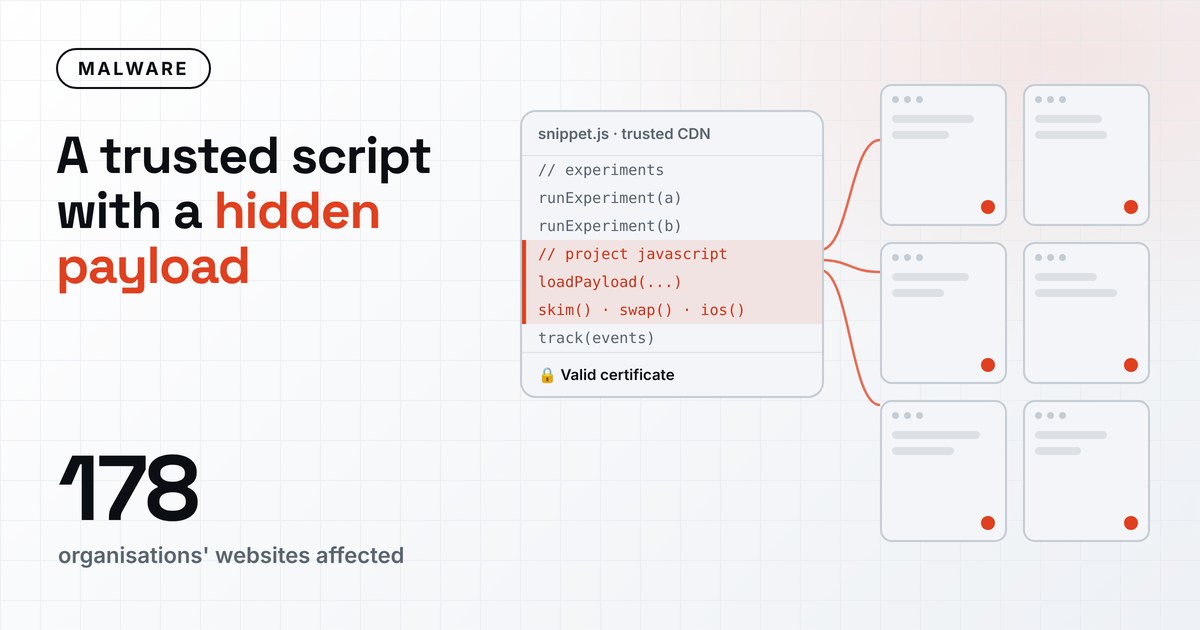
For most of 16 November, visitors to some of the world’s busiest websites were served malware without those websites being hacked. Attackers added malicious JavaScript to the Optimizely Web experimentation platform, which loaded it into the pages of 178 organisations, including Zoom, the BBC, CNN, Salesforce, GitLab, IKEA, HSBC, Equifax, Air France-KLM, Ledger and Peacock.
Scott Helme of Report URI, which monitors the scripts running on its customers’ websites, uncovered and documented the campaign. Most of the code was gone by that evening. Early on 17 November, Optimizely confirmed that “an unauthorized party exploited a vulnerability in Experimentation” to add the code to customer projects, and said the flaw has been fixed.
Update, 17 November: Optimizely blames a flaw in its platform
Optimizely’s incident report, posted at 01:02 UTC on 17 November, says the attacker exploited a vulnerability in Optimizely’s own Experimentation product, rather than, for example, breaking into individual customers’ accounts. In a post on X shortly afterwards, the company said it had “identified and contained” the incident, that “the vulnerable path is blocked” and that affected customers “have been contacted directly”.
According to the incident report, Optimizely has also:
- fixed the vulnerability and removed the injected code from affected projects
- taken steps to secure affected user accounts
- added protections to stop unauthorised code from being delivered.
The incident is still marked “Monitoring”.
Because the flaw was in Optimizely’s platform, its customers could not have stopped the code being added to their snippets. They could only limit the damage on their own websites, with a strict Content Security Policy, which blocked the payload on 24 of the affected sites, and with monitoring that spots when a trusted script changes. Both are covered below.
Optimizely has not described the vulnerability or said how many customers were affected. Nor has it said what “secure affected user accounts” involved. Earlier this year, the company confirmed a separate voice-phishing attack that reached its Zendesk, its Salesforce records and some internal documents. It said at the time that the attacker could not create backdoors in its environment. Nothing published so far links that incident to this one.
What happened
Optimizely Web lets marketing teams run A/B tests. Each customer’s website loads a JavaScript “snippet” from Optimizely’s content delivery network. Part of that snippet is a field called Project JavaScript, custom code the customer writes in their Optimizely dashboard that runs on every page.
The attackers wrote their loader into that field. The rest of each snippet was unchanged, and it was still served from Optimizely’s own CDN with Optimizely’s certificate, so to the affected websites it looked like their normal, trusted code. Report URI stresses that this was not CDN cache poisoning: Optimizely served exactly what it had been given. Even the snippets for Optimizely’s own website and login page carried the code.
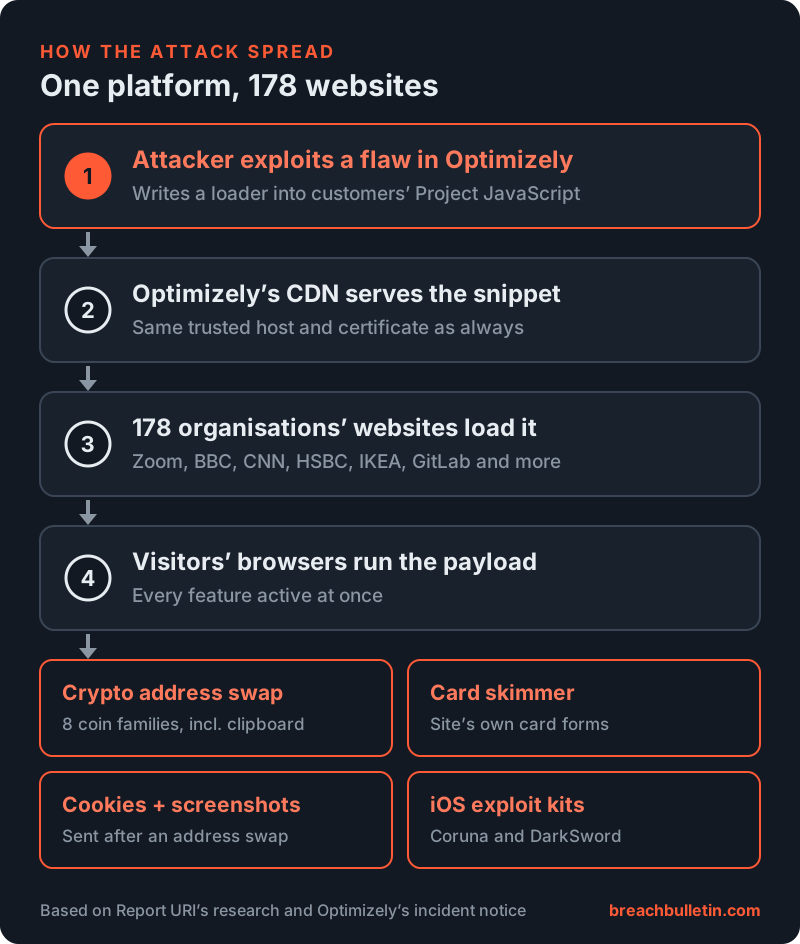
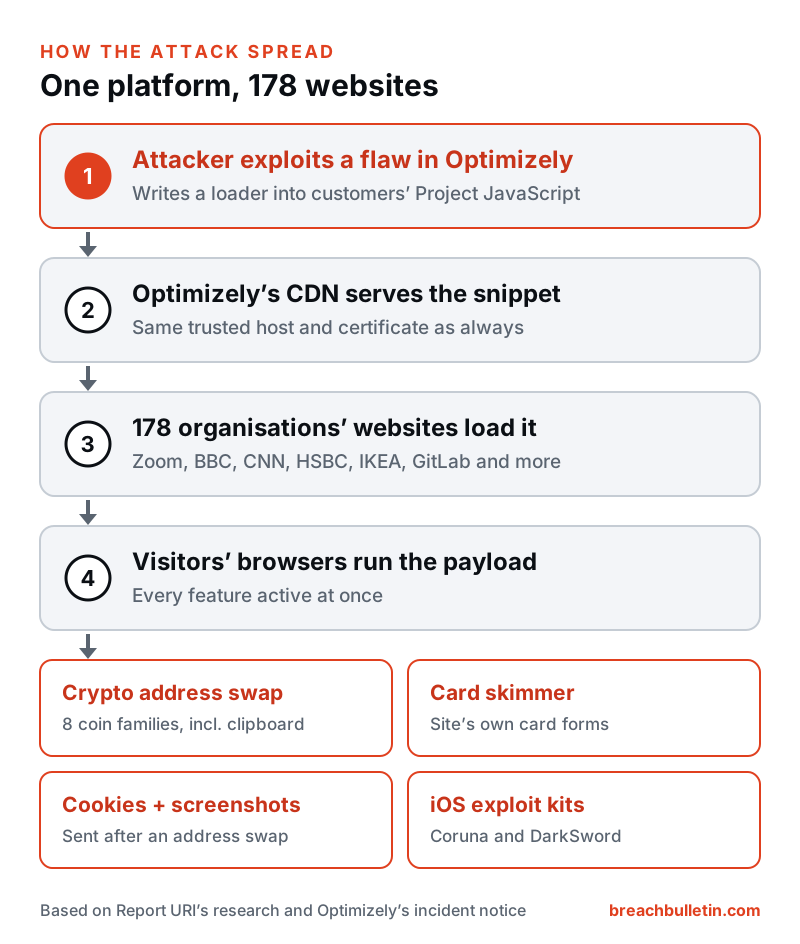
According to Report URI’s timeline, the first injection appeared in the BBC’s snippet at 04:21 UTC. The payload was rebuilt 26 times during the day as the attacker added features. A card skimmer was added at 13:43 UTC. In an evening sweep, Report URI found the code in 188 of the 1,611 Optimizely snippets it checked. The count fell from 169 infected snippets at 20:56 UTC to one by 21:52 UTC. Smartsheet’s snippet was cleaned and then re-infected, which shows the attacker still had access during the clean-up.
What the malware did
Every visitor received the same script, with all of its features active at once:
- It swapped cryptocurrency wallet addresses for the attacker’s own, covering Bitcoin, Ethereum and other EVM chains, TRON, Solana, TON, Litecoin, Bitcoin Cash and Dogecoin. It did this in page text, forms, links and the clipboard, so a pasted address could change without the user noticing.
- It skimmed card numbers, expiry dates and security codes typed into a site’s own form fields. Payments made inside hosted payment frames, such as Stripe’s or Adyen’s, were out of its reach.
- When it swapped an address next to wallet or payment wording, it also sent the attacker the page address, any cookies not protected with the HttpOnly flag and a screenshot of the page.
- On iPhones and iPads, it checked the iOS version and loaded an exploit kit in a hidden frame: Coruna for older devices and DarkSword for iOS 18. Google’s Threat Intelligence Group has documented both. Coruna targets iOS 13.0 to 17.2.1 and steals cryptocurrency wallet data, and DarkSword targets iOS 18.4 to 18.7. Every flaw they use is fixed in current iOS releases. On iOS 26 the script only fingerprinted the device.
By 19:25 UTC on 16 November, the attacker’s wallets had received about $7,040 in cryptocurrency, according to Report URI. It is not possible to tell from the blockchain how much of that came from victims of this attack.
The same attacker, earlier
Report URI links the Optimizely attack to earlier activity by the same attacker. From 13 November, the same injector was planted through other third-party scripts (Kissmetrics, StorifyMe and Minute Media) on sites including Security Bank, the Frankfurter Allgemeine Zeitung, the Sydney Morning Herald, vidaXL and Fox Sports. Its first known use was on Turkish websites in September.
Open questions
Optimizely has confirmed a flaw in its Experimentation product but hasn’t described it, or said how many customer projects were affected. No group has been named. Nobody has counted how many visitors received the payload, and no one has reported a confirmed compromise of an iPhone or iPad.
Indicators of compromise
Report URI published the domains used in the attack. They are written in
“defanged” form below, with [.] in place of the dot, so they can’t be clicked
by accident:
1688360[.]cc            command-and-control: track.js, card.php, hit.php
5vobauua3ojpklx[.]icu   iOS exploit-kit router (boot.js)
eil786npto9u5bq[.]icu   iOS exploit-kit router, Coruna and iOS 26 pages
l7bcsnwc7nzr3uo[.]icu   Coruna telemetry
webshell[.]lol          injector used in earlier waves
Report URI’s write-up lists further fallback domains. Defenders can also
search for the string 1688360 and for atob(, which one version of the
loader used to hide its address.
What stopped it on 24 sites
The 178 organisations had no flaw in their own code. They loaded JavaScript from a provider they trusted, and the attacker used that provider to reach their visitors. One marketing tool ended up delivering malware on some of the most-visited sites on the internet.
Browser defences could have limited the damage on those sites, if the sites
had set them strictly. A Content Security Policy (CSP) is a header that tells browsers which
scripts a page may load and where it may send data. Report URI
checked the CSPs
of the affected organisations’ websites: 68 had no CSP at all, and only 24
had one that blocked the payload outright. Allowing Optimizely’s CDN didn’t
help, because the malicious code came from that trusted host. The 24 sites
that stayed safe used a strict list of allowed script sources. Two common
settings, 'strict-dynamic' and 'unsafe-eval', let the attack through.
What to do
- iPhone and iPad users: update to iOS 18.7.3 or later, or iOS 26.3 or later. If a page kept reloading itself every minute on an older device, that was a symptom of the exploit retrying.
- Anyone who paid on an affected site on 16 November: if you typed card details into the site’s own form, rather than a Stripe, Adyen or similar payment window, treat that card as exposed and contact your bank.
- Anyone who sent cryptocurrency that day: check that the address you paid matches the one you intended. A swapped address is a sign of this attack.
- Optimizely customers: check whether you have received Optimizely’s
direct notice. If you have, ask for the details specific to your projects,
such as which ones were changed and when. If you haven’t, contact Optimizely
to confirm whether any of your projects were affected. Review every
project’s Project JavaScript and every experiment’s custom code for
1688360.cc,atob(and any script you didn’t write. Review who and what has write access to your account, including users, API tokens and integrations, and rotate credentials. Treat any secrets held in cookies without the HttpOnly flag as exposed. - All web teams: deploy a Content Security Policy that restricts where scripts can load from and send data to, and switch on its reporting. Use Subresource Integrity for third-party files that don’t change, and monitor the scripts that run on your pages so you notice when a trusted one changes.