

Java4Shell: a flaw in Java's Base64 decoder can crash servers and, in some apps, let attackers take over
A memory-corruption bug in Java, nicknamed Java4Shell, has prompted an urgent warning from the US Cybersecurity and Infrastructure Security Agency (CISA). In an alert on 17 November, CISA “strongly urges organizations to immediately patch” CVE-2026-114938, saying crafted input “could crash the JVM and allow for unauthenticated remote code execution”.
The flaw is in the code Java uses to decode Base64, a common way of sending binary data as text in login headers, tokens and file uploads. It only affects servers with recent Intel or AMD processors. Fixes were released on 17 November. There is no evidence yet of attacks in the wild.
How a single “=” corrupts memory
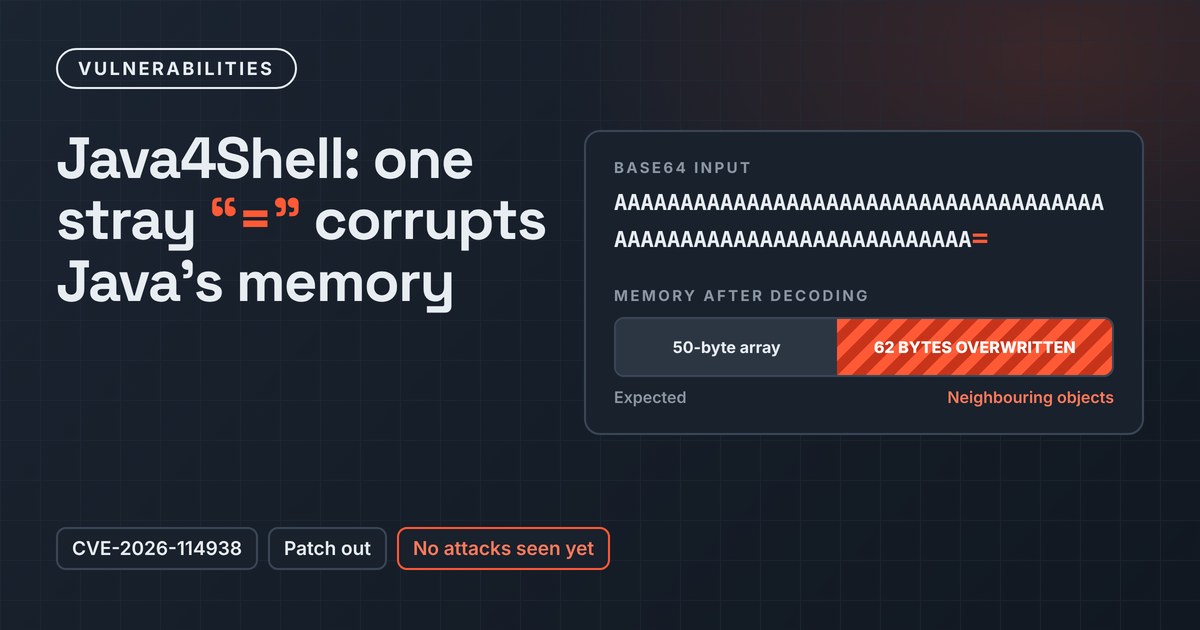
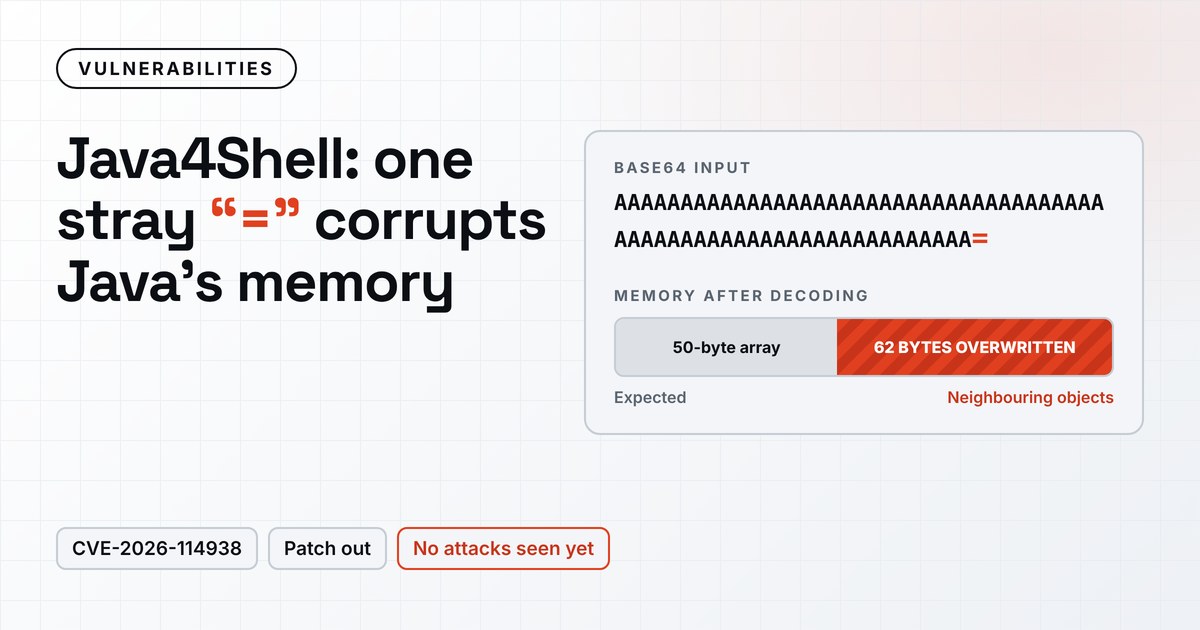
The bug was found by Quang Luong of the security firm Calif, which published a detailed write-up on 17 November. Oracle also credits a second researcher, Albert Yang, with reporting it. To decode Base64 faster, Java uses special AVX-512 instructions on processors that support them. That optimised code mishandles a stray “=” padding character at the end of certain inputs. For example, 64 letter A’s followed by “=” cause it to write 62 bytes past the end of the memory it was given.
Java then rejects the input as invalid, but by then the neighbouring memory has already been overwritten. Calif showed this can be used to read secrets from the server’s memory, in the style of the 2014 Heartbleed bug, and with more work to run code.
Which applications are at risk
Calif says it achieved remote code execution, in default configurations, in:
- Without logging in: Keycloak, Atlassian Jira, Atlassian Confluence, JFrog Artifactory, Jenkins and PingFederate.
- With a login: Apache Kafka, Apache Solr, Elasticsearch, Gerrit and Spinnaker.
It also demonstrated attacks on sample apps built with Apache Struts and Spring Boot. In addition, it describes a client-side attack, shared with it by researcher samczsun, in which a Java program that connects to a malicious server can be compromised.
There is no single exploit that works everywhere. Each target needs its own attack, built around how that application uses Base64. Calif has published a harmless test that shows whether a Java build is affected, but is holding back its application exploits “until everyone has had a chance to upgrade”.
Oracle, which rates the flaw 8.1 out of 10 and “difficult to exploit”, lists its own affected builds. Calif scores it 9.2 under the newer CVSS 4.0 system, and Red Hat rates it Critical.
Crashing a server takes seconds
Code execution takes work, but a crash is easy. Researchers at Blackpoint Cyber tested the flaw against a Spring Boot application using Spring Security. They sent about 28,300 unauthenticated login requests, each with a malformed Base64 value. The server rejected every one, but the Java process crashed after about 20 seconds.
That makes denial-of-service attacks realistic now, even before anyone publishes a full exploit. Blackpoint also found a quieter effect. In a controlled test, the corruption changed data inside the running application, flipping a setting from false to true without a crash. It did not show this leading to a real security bypass, and it did not reproduce code execution itself.
Who needs to patch
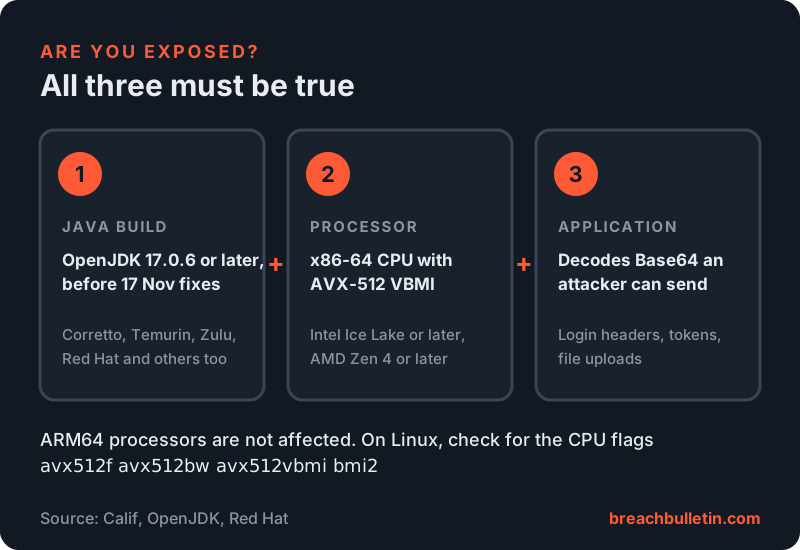
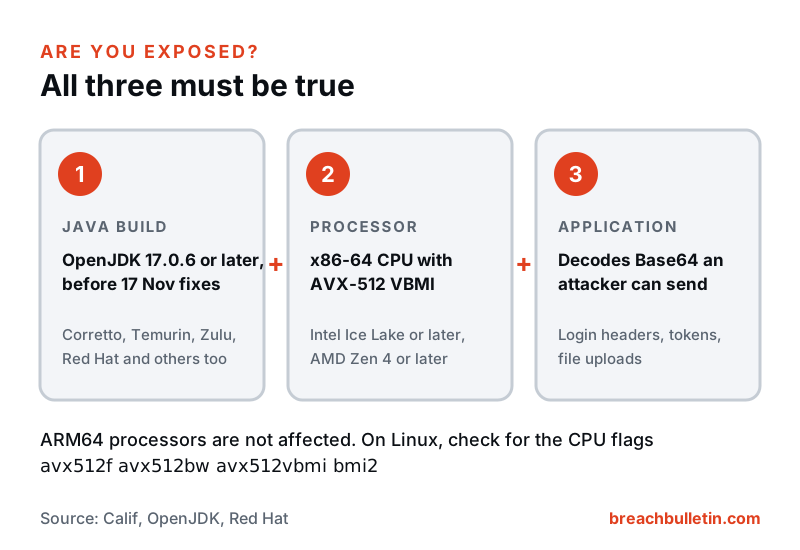
All three of these must be true for a server to be exposed:
- A vulnerable Java build. OpenJDK 17.0.6 and later on the 17, 21, 25 and 27 release lines, before the 17 November fixes. That covers most Java distributions, including Amazon Corretto, Eclipse Temurin, Microsoft’s build of OpenJDK, Azul Zulu, BellSoft Liberica, SAP SapMachine and Red Hat’s builds. Oracle also lists a Java 8 performance build (8u511b33-perf). Red Hat says standard Java 8 and 11 are not affected.
- A processor with AVX-512 VBMI. That includes Intel Xeon processors from Ice Lake onwards and AMD processors from Zen 4 onwards. ARM processors, including AWS Graviton, are not affected.
- An application that decodes Base64 an attacker can send. That is common in authentication, APIs and file uploads.
The fixed OpenJDK releases are 17.0.21.1, 21.0.13.1, 25.0.5.1 and 27.0.1.1. Each Java vendor numbers its builds slightly differently, so check the table below for yours.
Vendor advisories and fixed versions
These tables list only advisories published by the vendors themselves that name CVE-2026-114938, as of 20 November. Several are still being updated, so check the linked advisory for the latest status.
Java distributions
| Vendor and product | Fixed versions | Advisory |
|---|---|---|
| OpenJDK | 17.0.21.1, 21.0.13.1, 25.0.5.1, 27.0.1.1 | Advisory |
| Oracle Java SE | 17.0.21.1, 21.0.13.1, 25.0.5.1, 27.0.1.1. For GraalVM, see advisory | Patch update |
| Amazon Corretto | 17.0.21.1.2, 21.0.13.1.2, 25.0.5.1.2, 27.0.1.1.4. Amazon Linux packages also fixed | Amazon Linux |
| Eclipse Temurin | 17.0.21.1+2, 21.0.13.1+2, 25.0.5.1+2, 27.0.1.1+4, rolling out | Guidance |
| Microsoft Build of OpenJDK | 17.0.21.1, 21.0.13.1, 25.0.5.1 | Update |
| Azul Zulu (free builds) | 17.70.201, 21.54.201, 25.38.201, 27.30.201 | Release notes |
Linux distributions
| Vendor and product | Status | Advisory |
|---|---|---|
| Red Hat Enterprise Linux 8, 9, 10 and Red Hat build of OpenJDK | No fixed packages yet. Use -XX:UseAVX=2 until they arrive |
RHSB-2026-018 |
| SUSE Linux Enterprise 15 and 16 | Fixed Java 17, 21 and 25 packages are in testing, not yet released. Java 8 and 11 not affected | TID-JAVA4SHELL |
| Debian | Debian 13 (trixie): Java 21 and 25 fixed (DSA-6639-1, DSA-6640-1). Debian 12 (bookworm): Java 17 fixed (DLA-4917-1) | Tracker |
| Ubuntu | Java 17, 21, 25 and 27 fixed, and CRaC builds of 17, 21 and 25 fixed too | USN-9155-1, 9156-1, 9157-1, 9158-1, 9178-1, 9179-1, 9180-1 |
Applications and appliances
| Vendor | Status | Advisory |
|---|---|---|
| Atlassian | Bamboo, Bitbucket, Confluence, Crowd, Jira and Jira Service Management Data Center affected. Patches to follow; interim mitigation published. No action for Cloud customers | Data Center mitigations |
| Elastic | Elasticsearch 7.17.3 and later affected (code execution needs a user with read access). Fixes due in 8.19.26, 9.4.10, 9.5.7 and 9.6.0. Logstash 8.6.2 and later affected in some setups | Security announcement |
| Keycloak | Container images for 26.8 fixed from tag 26.8.2-3 | Keycloak blog |
| Jenkins | Upgrade the controller’s Java and restart. Interim flag -XX:-UseBASE64Intrinsics |
Jenkins blog |
| Okta | Access Gateway fixed in 2026.45.1, RADIUS Agent in 2.30.0. Auth0 not affected | Okta Security |
| Cisco | More than a dozen products affected, including Catalyst Center, Secure Workload and Intersight VA. No fixes or workarounds yet; planned releases named for a few, such as Finesse 15.0(1)SU3, with dates to be confirmed. IOS XE, UCS Central, ASA, FTD, ISE and others not affected | Cisco advisory |
| Citrix | Linux VDA (Virtual Apps and Desktops), Citrix Analytics, Endpoint Management (XenMobile Server), App Layering and UniconOS Management (Scout) affected, fixed builds to be announced. Secure Access under investigation. NetScaler, StoreFront, Workspace app and Cloudpaging not affected | CTX697367 |
| Siemens | Industrial Edge Management Pro V1, Pro V2 and Virtual affected, no fix yet | SSA-272816 |
| PaperCut | NG/MF 25.0.0 to 25.0.13 and 26.0.0 to 26.0.6 affected. Version 26.0.7 with fixed Java due week of 23 November; no 25.x fix confirmed yet. Manual mitigation available | Security advisory |
| Barracuda | Email Gateway Defense and MSP fixed by Barracuda. Data Inspector and WAF as a Service under investigation. Most other products not affected | Barracuda Trust Center |
| Sophos | Ten listed products not affected. Others still being checked | Sophos advisory |
| Splunk | Ten on-premises AppDynamics products and agents affected, fixes in progress. Splunk Enterprise, Cloud Platform, Universal Forwarder and SOAR not affected | SVD-2026-1102 |
| Fortinet | FortiOS, FortiProxy, FortiManager and FortiWeb among products not affected. FortiMail, FortiSIEM, FortiSandbox, FortiAnalyzer and many others still under investigation | FG-IR-26-278 |
| Palo Alto Networks | On-premises Idira products affected: Privilege Threat Analytics fixed in 15.2.3 and 14.6.4, Remote Access Connector in 1.1.1002202, HTML5 Gateway in 15.2.2.17 and 15.0.3.21. PAN-OS and Panorama not affected. Affected cloud services fixed by Palo Alto | Advisory |
| F5 | BIG-IP, BIG-IQ, F5OS and NGINX not affected. Distributed Cloud, NGINX One Console and AI Gateway under investigation. WAF signatures and an iRule published to protect Java back ends | K000164290 |
| Amazon Web Services | Patched Lambda Java runtimes rolling out; Lambda functions on default environments not affected. Customers on EC2 and ECS must update their own JDKs. Graviton (ARM) not affected | Bulletin 2026-189-AWS |
Red Hat’s bulletin also covers products built on RHEL, such as OpenShift, OpenStack and RHEL-based container images, as well as the Red Hat build of Keycloak and Red Hat Single Sign-On 7.6 on Java 17. Amazon says it has no plans to fix its short-term Corretto releases (22, 23, 24 and 26), so anyone still using those should move to a supported release.
SAP has put SapMachine 17.0.21.1, 21.0.13.1 and 25.0.5.1 on its official download page, but we have not found an SAP advisory that names this flaw. We also haven’t found advisories from BellSoft (Liberica), or from JFrog and Ping Identity, whose Artifactory and PingFederate products Calif says it could compromise. Until your software vendors confirm, assume any product that bundles Java 17 or later may be affected.
Finding every copy of Java
CISA’s alert asks organisations to review their software inventory for every Java runtime, “including those bundled with third-party applications or included in container images and appliances”. It warns that these “may not appear as separate entries” in inventories. Many products ship with their own copy of Java, so patching the operating system’s Java may not be enough.
Steps to take
- Update Java to the fixed version from your Java vendor, starting with internet-facing systems and login services. Then update every application, container image and appliance that bundles its own Java, as each vendor releases fixes.
- If you can’t patch yet, switch off the vulnerable code. Calif says
either of these Java startup options mitigates the flaw, and both stopped
the memory corruption in Blackpoint’s standalone tests:
-XX:-UseBASE64Intrinsicsturns off the optimised Base64 code.-XX:UseAVX=2turns off AVX-512 entirely. Red Hat recommends this one. Use it only on x86-64 servers, because Java on ARM will fail to start with it.
- Don’t rely on input limits alone. CISA suggests validating and limiting the size of Base64 input and restricting unauthenticated access as temporary measures. These help, but Blackpoint says size limits and input validation should not be relied on instead of patching, and Calif found that request buffering at a proxy is not a general fix either.
- To check a processor on Linux, look for all four of the flags
avx512f,avx512bw,avx512vbmiandbmi2in/proc/cpuinfo. - CISA advises monitoring for unexpected Java crashes, rogue Java runtimes and suspicious Java processes. Repeated crashes of a Java service could be a sign of attempted exploitation.
Calif says it found the flaw in about an hour with an AI coding agent and built its first working exploit two hours later, so don’t wait for reports of attacks before patching. We covered the same speed-up in Google’s latest threat report and in today’s Puppet Server flaw.