

Exploited Puppet flaw lets one report take over the server that configures your fleet
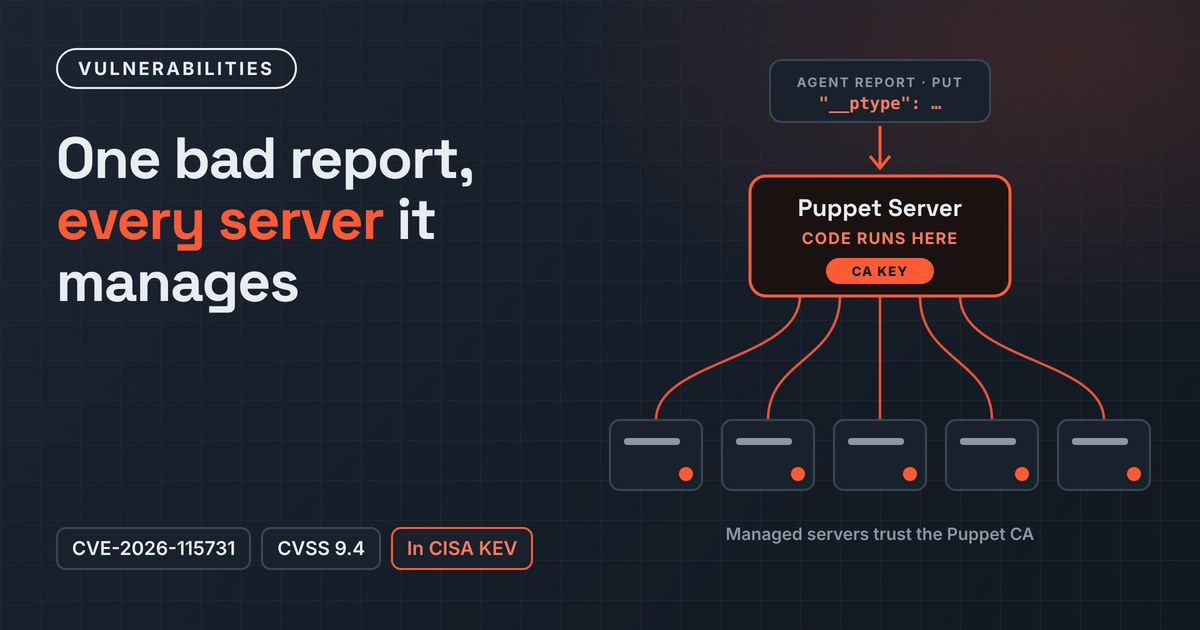
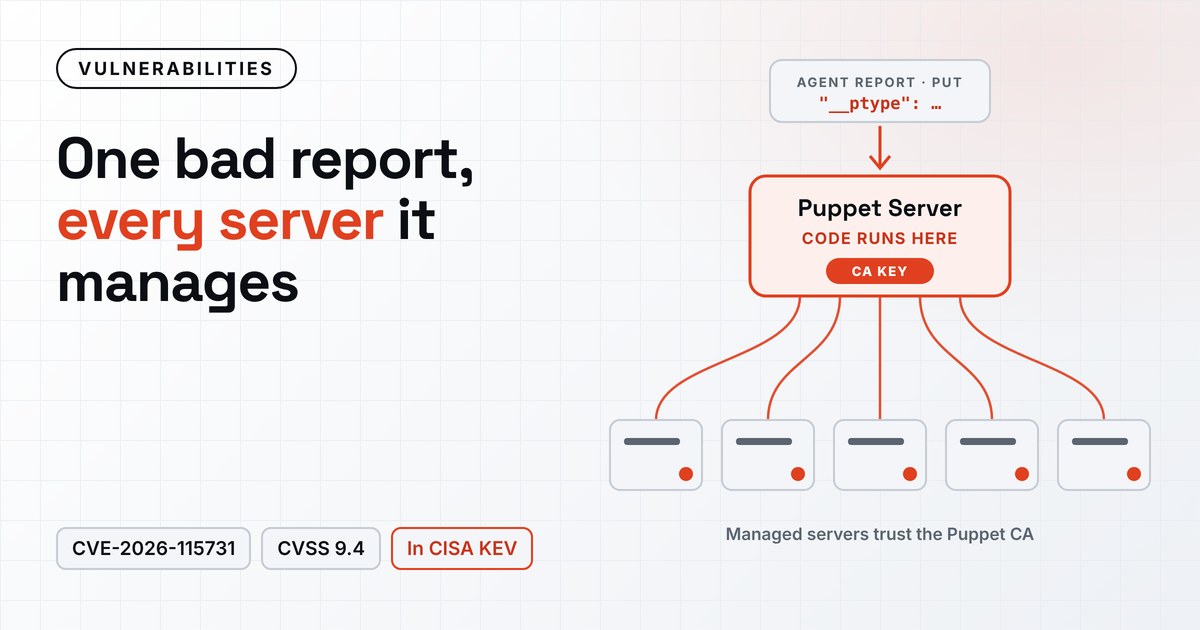
Attackers are exploiting a critical flaw in Puppet Server, the central server that pushes configuration to the machines it manages. On 17 November the US Cybersecurity and Infrastructure Security Agency (CISA) added CVE-2026-115731 to its Known Exploited Vulnerabilities (KEV) catalogue, based on evidence of active exploitation. US federal agencies have until 1 December to fix it.
Fixes have been available since 3 November. Puppet’s maker, Perforce, rates the flaw 9.4 out of 10. According to its advisory, any client that holds a Puppet agent certificate can run code on the Puppet Server by sending it a single crafted report.
What the flaw is
After each run, a Puppet agent sends the server a report: a JSON document listing what it changed and any errors. The open-source OpenVox project explains that in some cases these reports can contain serialised Ruby objects, which the server turns back into live objects when it processes the report. A maliciously built object makes the server run the attacker’s code as it does so. The code runs as the Puppet Server’s service user.
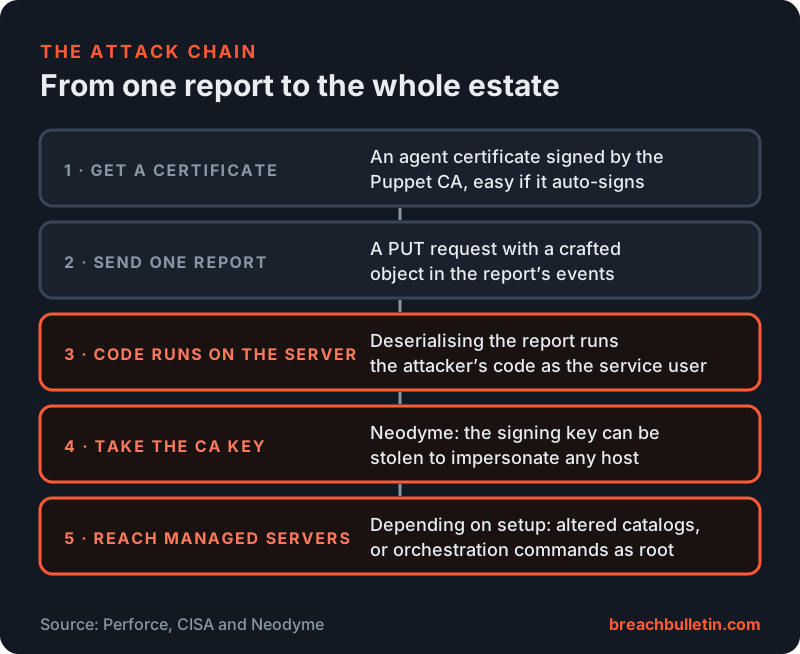
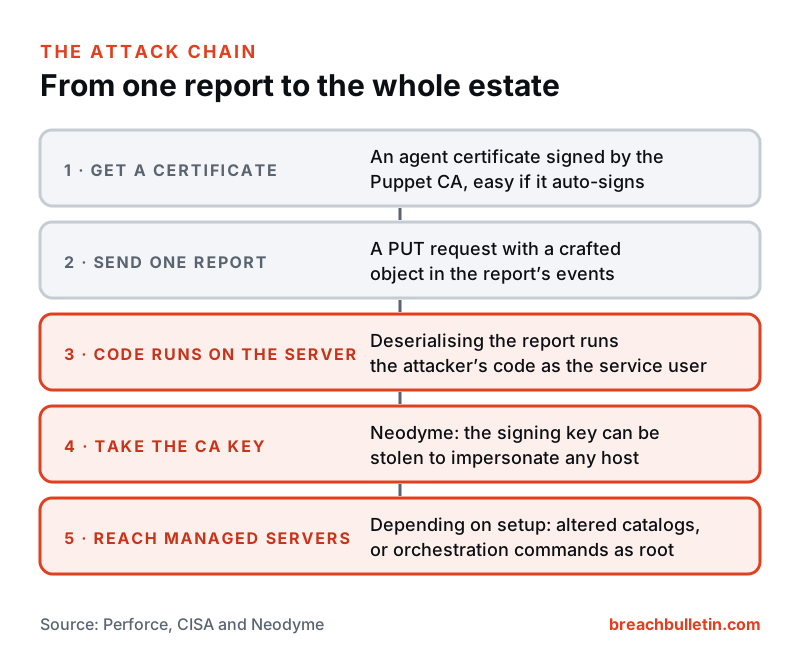
The attacker needs a client certificate signed by the Puppet certificate authority (CA), and many setups hand those out freely. Perforce warns that where the CA “autosigns requests without strong verification, an unauthenticated network attacker can obtain such a certificate”. Automatic signing is often switched on to make it easy to add new servers.
What an attacker can do next
A Puppet server holds the keys to every machine it manages. Alain Rödel of Neodyme, who found the flaw, showed that code running on the server can steal the CA’s signing key and then issue certificates that let an attacker impersonate any host. What else an attacker can do depends on how Puppet is set up:
- If the server doesn’t follow Puppet’s best practices, the attacker can change the configuration sent to managed machines and run code on them at their next check-in.
- On Puppet Enterprise, Neodyme used the stolen CA key to run commands as root on managed hosts through the orchestration service.
- On OpenVox with Choria configured, the attacker could trigger predefined tasks on managed hosts.
Neodyme also found that configuration delivered by Puppet often contains secrets. In one test, a catalog held database passwords, admin API tokens and application logins.
A second flaw, not yet exploited
Perforce fixed a second critical flaw at the same time.
CVE-2026-115732
(9.0 out of 10) is a mistake in how Puppet Server checks certificate names. A
certificate for evil.web01.example.com could be treated as web01.example.com
and used to impersonate it. In Puppet Enterprise, Perforce says, that can lead
to CA administration and remote command execution on managed nodes. It needs a
certificate with a colliding name, which a CA could issue through automatic
signing.
This flaw is not in CISA’s KEV catalogue, and there are no public reports of it being exploited.
Who is affected and what to install
| Product | Vulnerable | Fixed in |
|---|---|---|
| Puppet Enterprise 2026 | 2026.0.0 | 2026.0.1 |
| Puppet Enterprise 2025 | 2025.0.0 to 2025.12.0 | 2025.12.1 |
| Puppet Enterprise 2023.8 | 2023.8.0 to 2023.8.12 | 2023.8.13 |
| Puppet Core 9 | 9.0.0 to 9.1.2 | 9.1.3 |
| Puppet Core 8 | Before 8.22.2 | 8.22.2 |
| OpenVox Server | All earlier versions | 9.2.0 and 8.18.0 |
| OpenVox Agent | All earlier versions | 9.3.0 and 8.32.0 |
| OpenVoxDB | All earlier versions | 9.2.0 and 8.18.0 |
Old open-source Puppet will not be fixed. OpenVox says that “all known Puppet implementations” are vulnerable, and that open-source Puppet “will not be receiving any more updates, security or not”. Neodyme confirmed the code execution flaw works on Puppet 6.24.0 from 2021. If you still run open-source Puppet, the only fix is to move to OpenVox or to Perforce’s Puppet Core.
What is known about the attacks
CISA has not said who is exploiting the flaw, how, or whether ransomware groups are involved. Technical details have been public since 3 November, when Neodyme published its write-up alongside the fixes. SecurityWeek reports that a proof-of-concept exploit for OpenVox followed shortly afterwards, and points to a Reddit post from 4 November in which an administrator said they traced activity on their systems to an intrusion using this flaw. That account has not been independently confirmed.
Neodyme says it found both flaws with the help of AI, but only with “precise steering” by experienced researchers. Google’s threat intelligence team described the same speed-up in finding and weaponising flaws in its latest report.
Steps for Puppet admins
- Upgrade Puppet Enterprise, Puppet Core or OpenVox to the fixed versions in
the table above. If you have custom rules in
auth.conf, check they still work afterwards: OpenVox warns that some may have relied on the buggy name matching. - Turn off automatic certificate signing, or limit it to requests you can verify, for example with a policy-based autosign script.
- Allow connections to the Puppet Server’s port (8140 by default) only from the networks that need it.
- Run
puppetserver ca list --alland look for hosts you don’t recognise, and for names that extend a real hostname, such asevil.web01.example.com. - If a server was unpatched and reachable, treat it as compromised. Investigate it, and plan to re-issue the CA and every agent certificate. Rotate any secrets stored in Hiera, in Puppet code or in configuration that Puppet delivers.
- Limit the damage of any future compromise. Neodyme notes that if catalogs are owned by a different user from the server process, code running as that process can’t change them. Restrict orchestration to what you need, and keep secrets out of catalogs.
For how KEV listings and the federal deadlines work, see our recent KEV round-up. Yesterday we also covered another deserialisation flaw under attack, in the Apache Roller blog server.