

Java4Shell scanning has started, and many vendors still have no fix
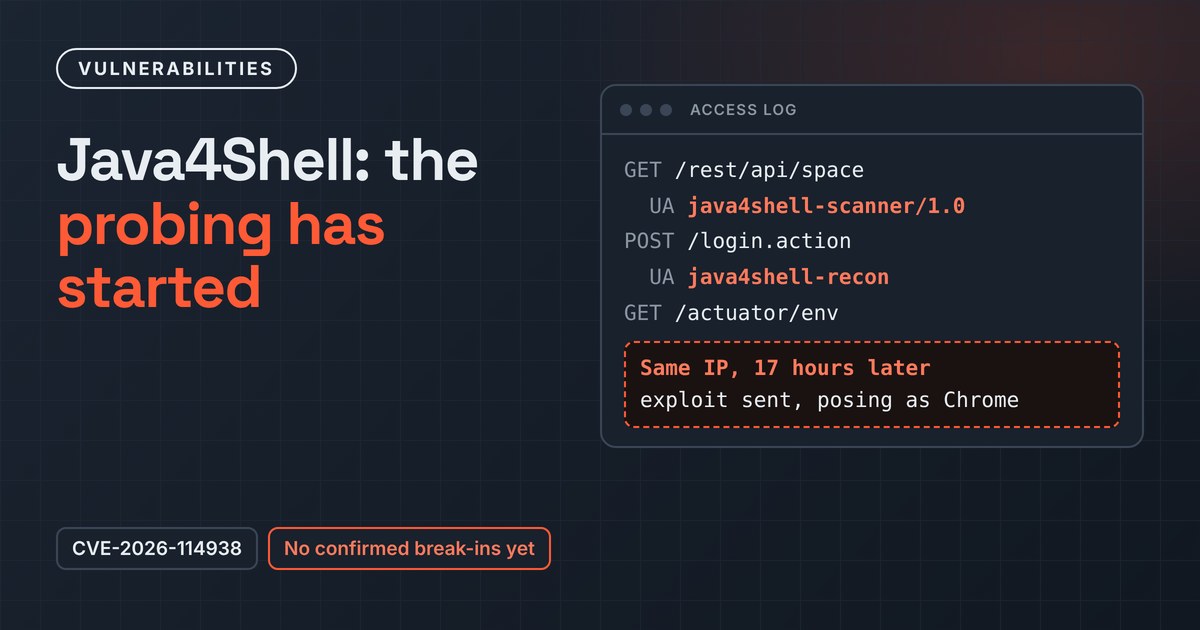
Three days after Java4Shell was disclosed and patched, attackers have started trying it. Several companies that run internet sensors report scans and exploit attempts against CVE-2026-114938, the memory corruption flaw in how OpenJDK decodes Base64. None of them has confirmed a successful intrusion so far.
As a reminder, the flaw affects OpenJDK 17.0.6 and later builds released before 17 November, but only on x86-64 processors that support AVX-512 VBMI. ARM servers are not affected. Calif, the firm that found it, says it got remote code execution without a login against default installs of Jira, Confluence, Jenkins and Keycloak.
Who has seen what
GreyNoise has a live tracker for
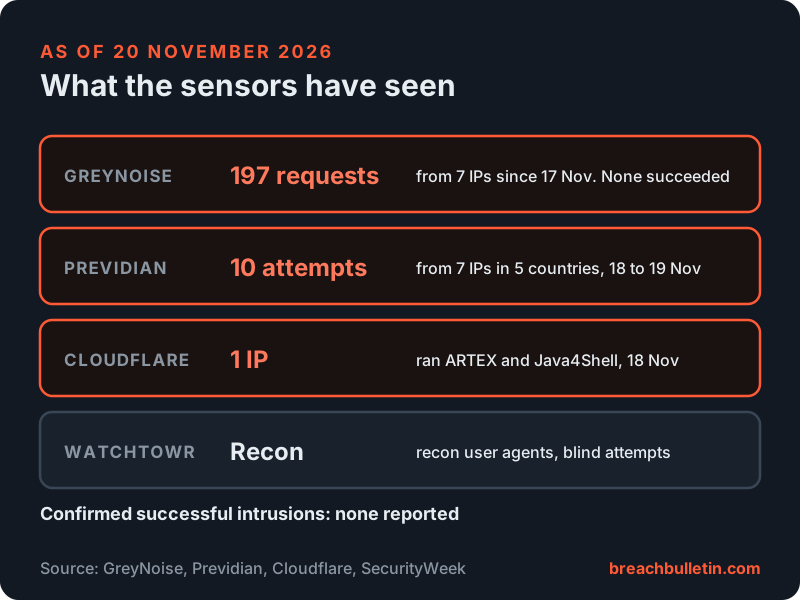
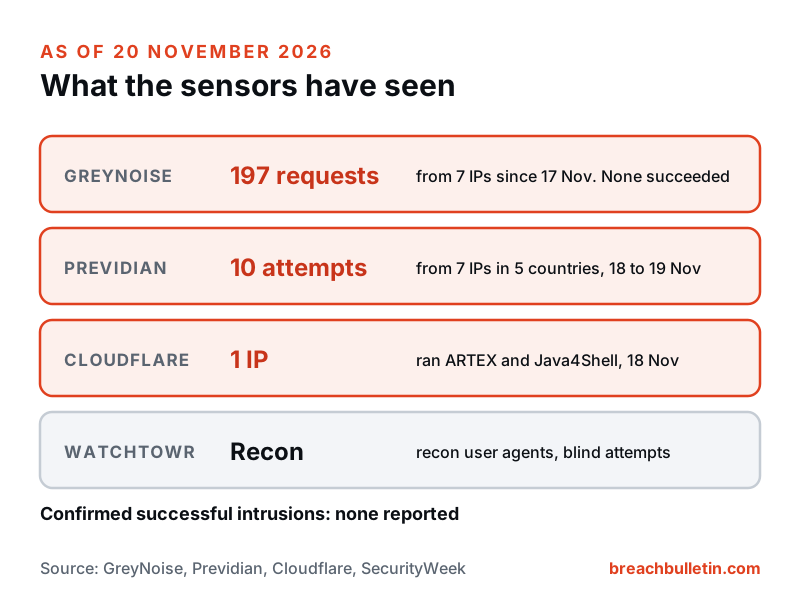
the flaw. When we checked it early on 20 November, it listed 197
Java4Shell-shaped requests from seven IP addresses since 17 November, and “no
confirmed successful exploitation” against its sensors. The requests go after
paths such as /rest/api/space and /login.action (Confluence),
/actuator/env (Spring Boot) and /api/login, and some identify themselves
as java4shell-scanner/1.0. SecurityWeek’s report on 19 November quoted
smaller numbers, so the count is still climbing.
Previdian now records 10 exploitation attempts from seven IP addresses in five countries, first seen on 18 November and last seen on 19 November. Its sensors can show that an attempt was made, not that it worked.
Jake Knott of watchTowr told
SecurityWeek
that his team is seeing java4shell-recon user agents and blind attempts
that don’t work yet. Because each attack has to be built around how a
particular application uses Base64, he expects attackers to work through
products one at a time. We couldn’t find a watchTowr post of its own on this.
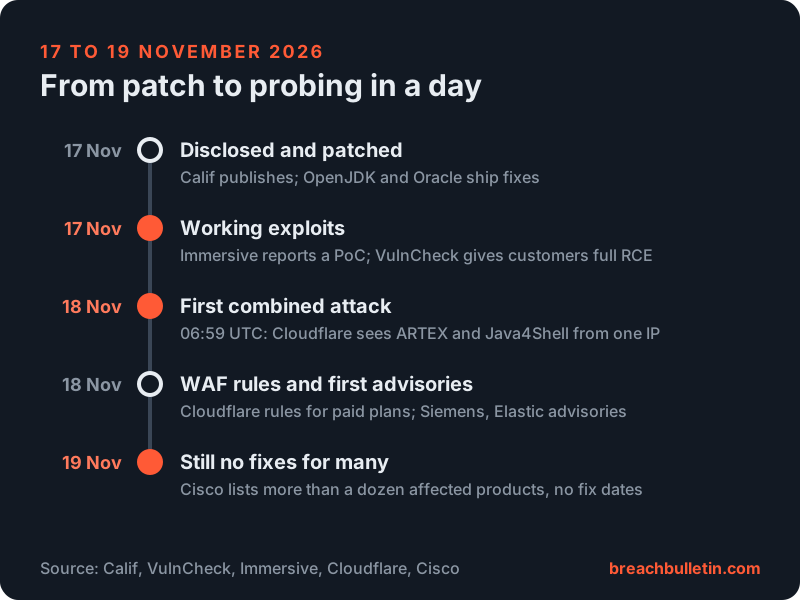
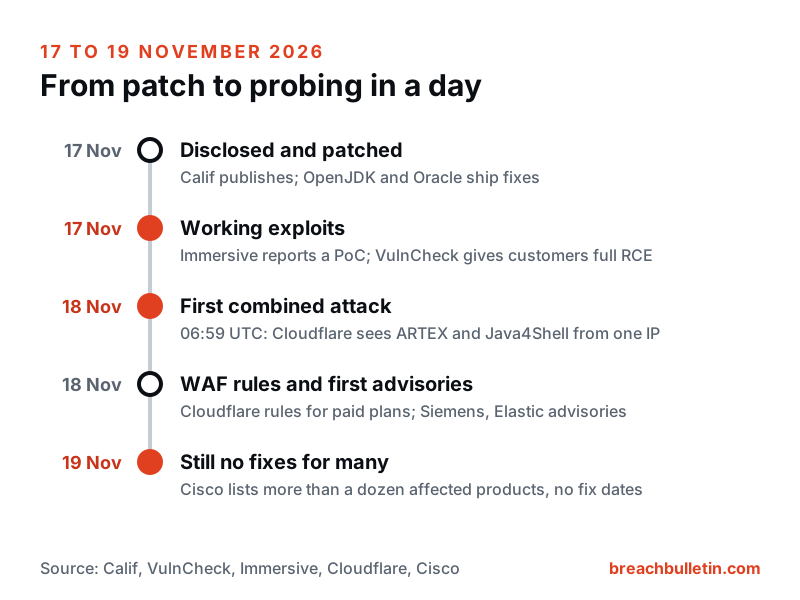
Cloudflare’s threat team, Cloudforce One, made two observations on X. At
06:59 UTC on 18 November it saw
ARTEX and Java4Shell activity from the same IP address
for the first time, which it reads as attackers combining new
vulnerabilities. ARTEX is the AI attack framework that
Barracuda says was used
against its cloud. Cloudforce One also found that
scanners are hiding their names:
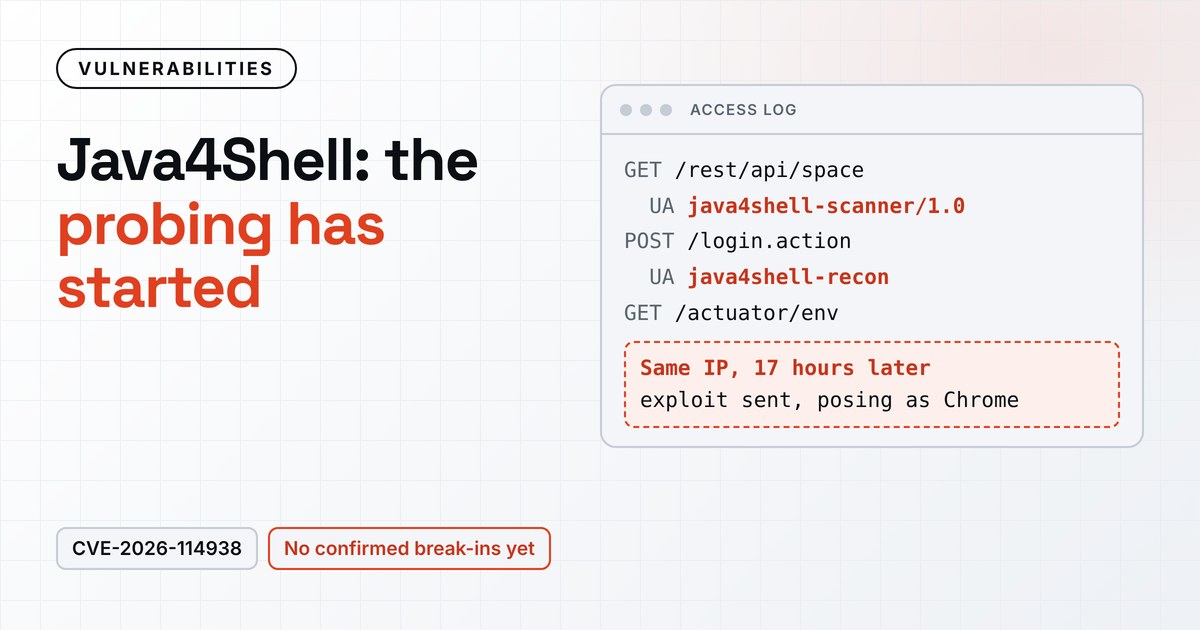
one IP probed a target with a java4shell-* user agent, then came back about
17 hours later with the exploit trigger while claiming to be Chrome. Blocking
on user agent alone won’t catch that.
Exploits exist, but not in public
VulnCheck says it had a full remote code execution exploit ready for its paying customers by the evening of 17 November. Crashing a vulnerable server is easy, the company says, but turning the bug into code execution takes heap grooming and a memory leak. VulnCheck has also published Snort, Suricata, Sigma and YARA rules.
Kevin Breen of Immersive posted the same day that he had a working proof of concept. He stressed that it isn’t generic: each exploit has to target a specific application, and he named Tomcat’s basic authentication and the java-jwt library as paths that can be exploited before login.
Cloudflare added six WAF managed rules for Pro, Business and Enterprise plans on 18 November. They only log by default, so you have to switch them to block. A rule for the Free plan is still being worked on.
Products still waiting for a fix
Patching the JDK on your own servers is the easy part. The harder part is Java bundled inside products you can’t patch yourself.
Cisco lists more than a dozen affected products, including Catalyst Center, Secure Workload, Secure Network Analytics, Intersight Virtual Appliance, Finesse and Smart Software Manager On-Prem. None has a fixed release date yet, and Cisco says there are no workarounds. It knows of proof-of-concept code but no malicious use. Since SecurityWeek’s report, Cisco has moved IOS XE and UCS Central from “under investigation” to not affected, alongside ASA, Firepower Threat Defense, ISE and NX-OS.
Siemens says Industrial Edge Management Pro V1, Pro V2 and Virtual are affected, with no fix. Its advice is blunt: shut the instances down or cut their internet connection until a fix is out.
Elastic confirms that Elasticsearch 7.17.3 and later is vulnerable on affected CPUs. Code execution needs a user with at least read access, but anyone who can reach a node can crash it. Logstash 8.6.2 and later is affected only in some setups. Fixes will come in 8.19.26, 9.4.10, 9.5.7 and 9.6.0, which update the bundled JDK. Kibana, Beats and Elastic Agent don’t use Java. Elastic says fewer than 5% of its Elastic Cloud Hosted deployments, all on Azure, run on affected CPUs, and it is applying a configuration fix to them.
Atlassian
has no patches yet for its Data Center products. Until they arrive, it tells
customers to add -XX:UseAVX=2 to the JVM options, which turns off AVX-512,
and has published instructions for each product, including Bamboo agents and
Docker and Kubernetes installs. Cloud customers don’t need to do anything.
Red Hat
rates the flaw Critical for RHEL 8, 9 and 10 and its builds of OpenJDK 17, 21
and 25, noting that researchers have shown working exploits against widely
used Java applications in their default configurations. Fixed packages
weren’t out when we last checked, so it also recommends -XX:UseAVX=2 for
now.
Some fixes have landed. Keycloak container images are fixed from tag 26.8.2-3, and Jenkins has mitigation guidance. Amazon, Microsoft and Azul have shipped patched JDKs. Oracle’s November Critical Security Patch Update, released on 17 November, includes the Java SE fix among 655 new security patches.
Our vendor table in the original article lists fixed versions and advisory links for each vendor.
Why bundled Java is the problem
Appliances and third-party software ship their own Java runtime, and you usually can’t update it without the vendor’s help. Those products are often reachable from the network, and they are often the last to get patched. Log4j showed the same pattern in 2021, when fixes for bundled copies trailed for months.
The ARTEX overlap matters too. If attackers are adding Java4Shell to automated toolkits, they can try it against every exposed Jira or Keycloak server they find, without anyone writing a custom attack for each one.
Steps to take now
- Patch every JDK you control to the 17 November releases or later.
- Make an inventory of bundled Java, including container images, appliances and vendor software. Check each vendor’s advisory, starting with the ones above.
- Where there is no fix, apply the vendor’s workaround. For most products
that means adding
-XX:UseAVX=2to the JVM options and restarting. Follow Siemens’ advice and take Industrial Edge Management offline. - Limit who can reach login pages, APIs and admin consoles of affected products, especially from the internet.
- If you use Cloudflare, switch its Java4Shell WAF rules from log to block.
- Search web and proxy logs for
java4shellin user agents, and for requests to the paths GreyNoise lists. A scanner that showed its name once may come back disguised, so look at what each IP did afterwards. Unexpected JVM crashes on internet-facing Java services are worth investigating too.
For how the flaw works and how to find every copy of Java you run, see our first Java4Shell article.