BYOD ransomware gang plays spoken ransom demands on hospital and university computers
On this page
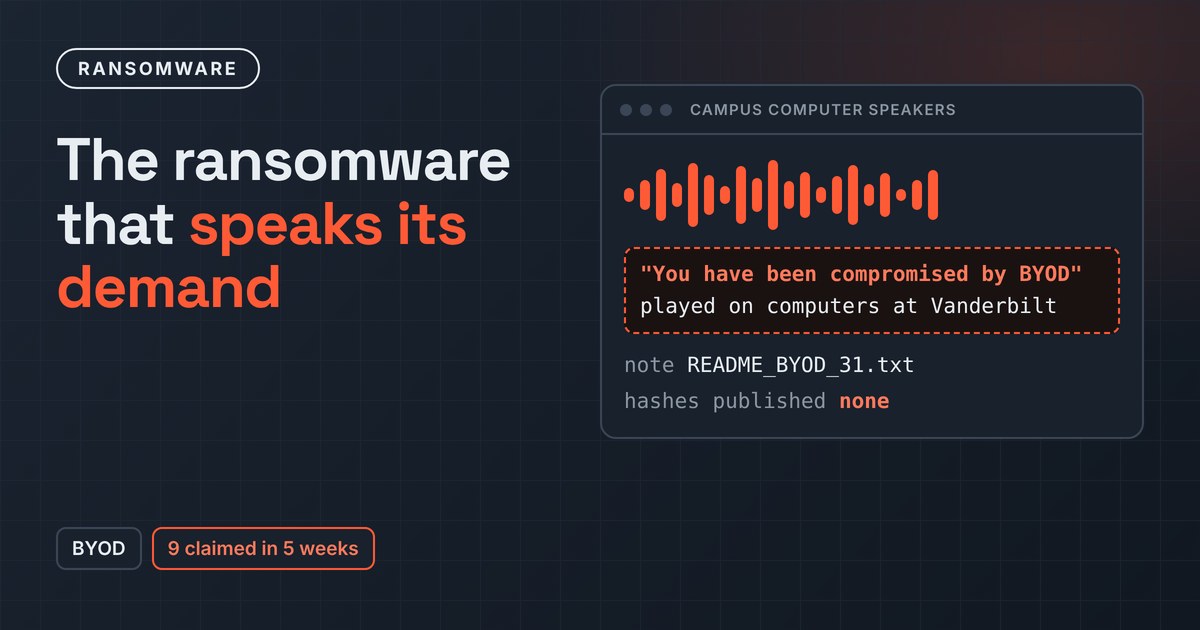
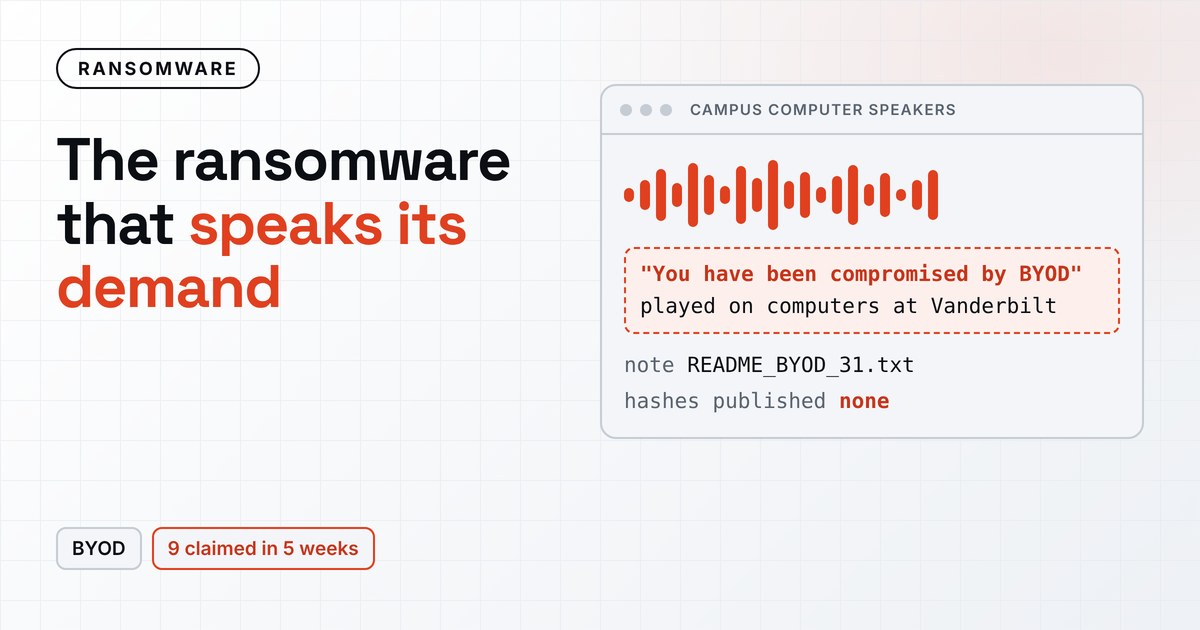
Staff at the University of New Mexico’s health system heard their computers announce that patient data had been stolen. Two weeks later, campus computers at Vanderbilt University played a voice saying “You have been compromised by BYOD”, followed by a demand to make contact. Both attacks are linked to a new ransomware and extortion group that calls itself BYOD.
TrendAI, Trend Micro’s research team, says the group claimed at least nine organisations between 5 October and 9 November. Only a few of those attacks have been confirmed by the victims, and almost none of the group’s claims about what it stole.
UNM: ambulances diverted for two hours
On Monday 26 October, the University of New Mexico Health System diverted all ambulances and cancelled appointments because of what it called a “cybersecurity issue”. UNM Hospital is the state’s only Level I trauma centre. According to TrendAI and local reports, ambulance traffic was diverted from 12:30 to 2:30 pm, more than 30 clinics cancelled appointments and outpatient surgeries, and classes were cancelled across several colleges. Other Albuquerque hospitals took extra patients, and the FBI is assisting.
UNM says the attack affected some end-user devices but didn’t reach its core systems or servers, and that it paid no ransom. By the next day its hospitals and clinics were back to normal. BYOD claims it compromised 36,000 systems, including Active Directory, Microsoft Entra and two Oracle databases, and stole patient, student and employee data. None of that has been confirmed.
Vanderbilt: “shut down university devices”
On 9 November, Vanderbilt told students, faculty and staff to shut down university devices, disconnect from campus Wi-Fi and “remain extremely vigilant” while it dealt with an incident that might affect devices, systems and cloud services. It warned people to watch for unfamiliar applications and unexpected login approval requests. Wi-Fi came back that evening, and other services returned in stages over the following days.
BYOD claimed the attack the same day. It says it encrypted databases, took
control of a domain controller and stole research data and more than a million
Social Security numbers. Vanderbilt hasn’t confirmed BYOD’s involvement,
encryption or data theft. The ransom note reported at Vanderbilt is called
README_BYOD_31.txt.
Michigan State and the rest
BYOD added Michigan State University to its leak site on 1 November, claiming data on 1.3 million current and former students. MSU told The Record that the claim was tied to suspicious activity it found in early October. On 1 October it made every account holder reset their password to one of at least 15 characters. MSU says the activity looked like a credential compromise, and that it has no evidence its central Active Directory was compromised or that data was stolen.
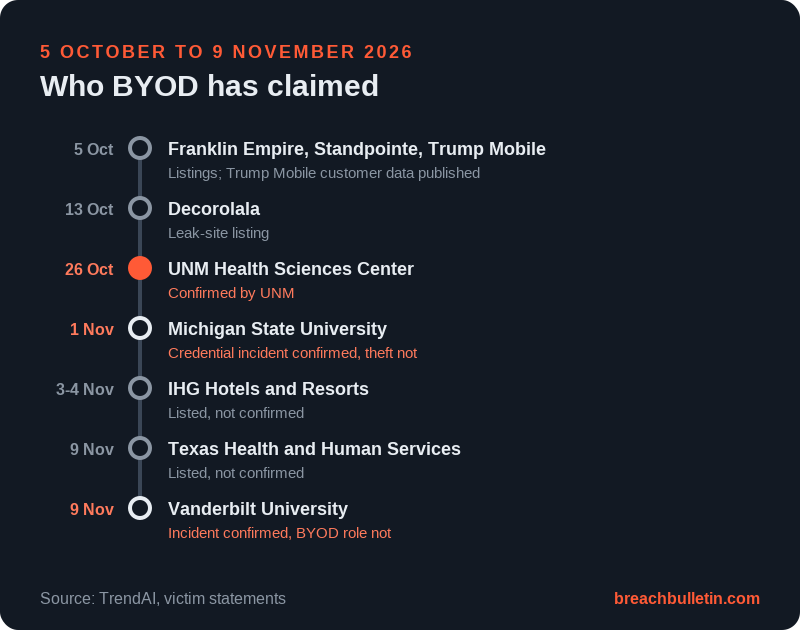
The group’s leak site also lists IHG Hotels and Resorts and the Texas Health and Human Services Commission, neither of which has confirmed an incident. It published data on 3,615 customers of Trump Mobile, which a group member said came from a remote access trojan on a computer at a third-party carrier. Some people in that dataset have confirmed their details are accurate.
What isn’t known
The name invites a theory: that the group gets in through personal phones and laptops on campus networks. Nothing supports that yet. TrendAI points out that the group hasn’t explained its name, and nothing links it to “bring your own device”. At Vanderbilt and UNM, the instructions were about university-owned devices.
TrendAI says it has no malware sample, and no file hashes, IP addresses or domains have been published. Its picture of the group rests on victim statements, news reports and BYOD’s own posts. Nobody has shown how the audio messages were played, how the group gets in at most victims, or what encryption tool it uses. No software vulnerability has been tied to any of the attacks. The one confirmed pattern is identity: MSU’s stolen credentials, and the group’s claims about Active Directory, Group Policy and Entra tenants.
What hospitals and universities can do
- Treat identity as the front line. Require phishing-resistant MFA for remote access, administrators and cloud sign-ins, and use number matching where push approvals remain.
- After any credential reset, check what the affected accounts accessed before the reset, not only after it.
- Watch for the activity TrendAI highlights: new members of privileged groups, Group Policy changes, unusual admin sign-ins, bursts of MFA prompts and large database exports.
- Search endpoints and file shares for
README_BYOD_*.txt, and report computers that start playing audio messages. - Keep guest and personal devices on separate networks from clinical and administrative systems. That’s good practice for these sectors anyway, whatever the gang’s name means.
- Keep tested offline backups of directory services and key databases, and rehearse downtime procedures that don’t need the network.
- Tell patients, students and staff not to respond to anyone who contacts them claiming to hold their data, and give them a trusted place to report it.
For another case of a ransomware group’s claim outrunning the evidence, see Nvidia’s response to The Gentlemen.