Inkling 2 Mini is Apache 2.0 with a 1M-token context, but read the use policy too
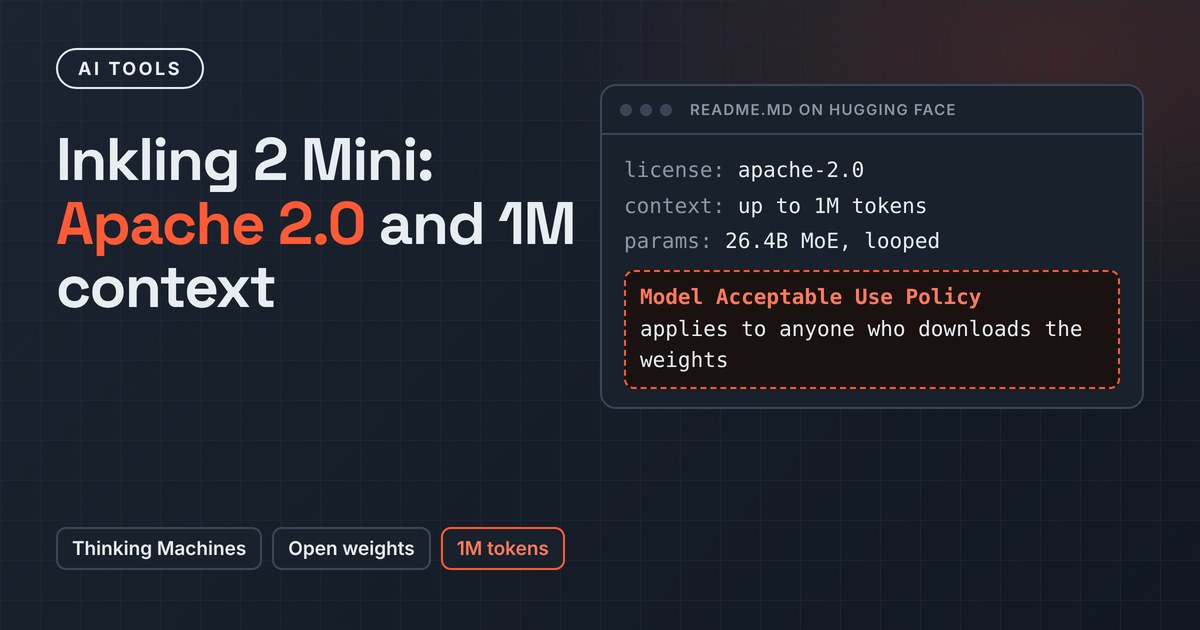
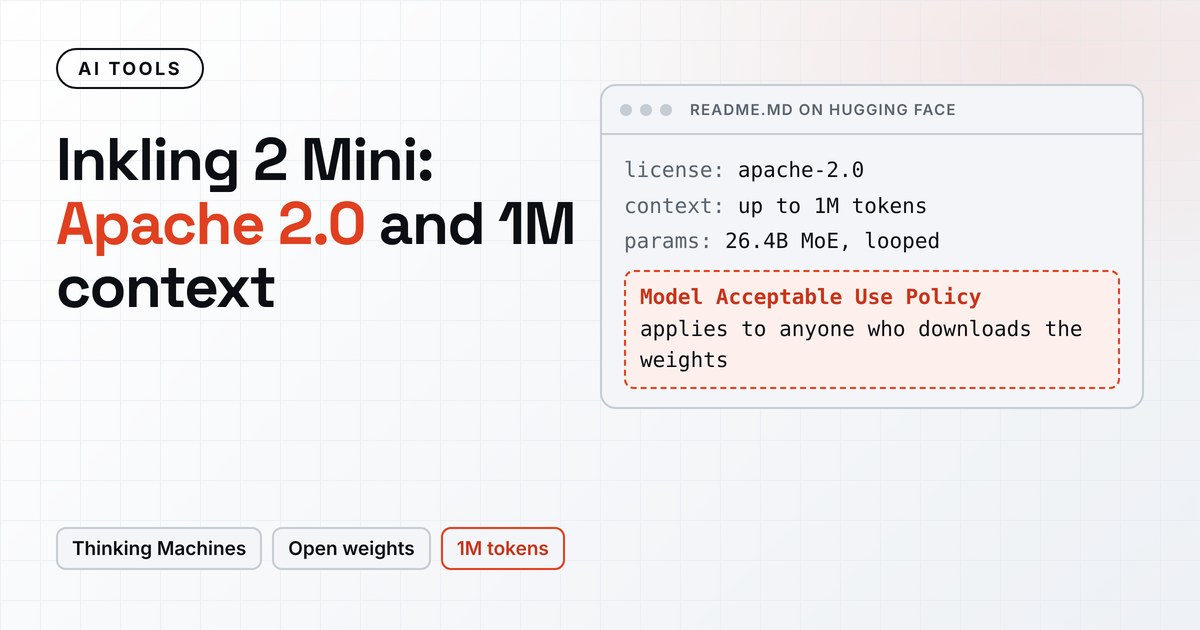
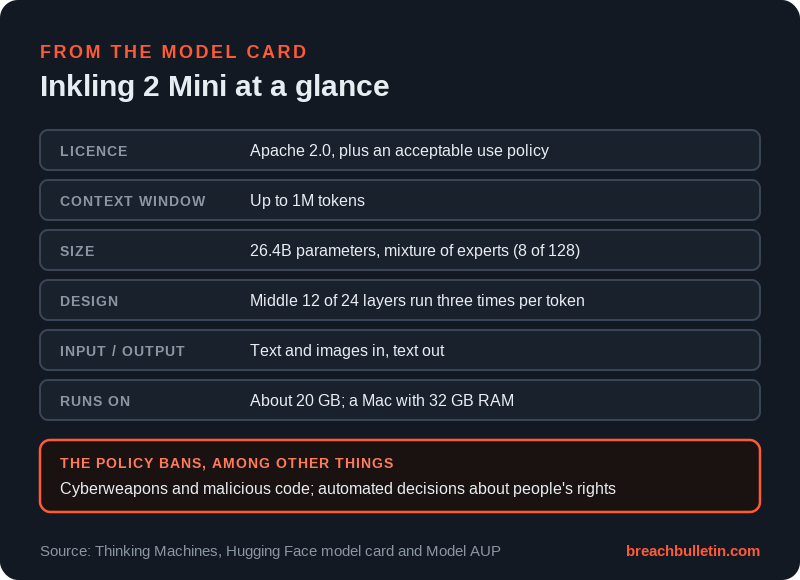
Thinking Machines Lab released Inkling 2 Mini, a small open-weight model meant to run on a laptop, on 20 November. Its announcement described the model and its benchmark results but didn’t name a licence or a context length. Both are now confirmed in the model card on Hugging Face: the model is licensed under Apache 2.0, and “Inkling 2 Mini supports a context window of up to 1M tokens.”
What the model is
Inkling 2 Mini is a mixture-of-experts model with 26.4 billion parameters in total, routing each token to 8 of 128 experts. Its unusual feature is looping: the middle 12 of its 24 layers run three times for every token, which Thinking Machines says lets it reason longer without writing its reasoning down. It takes text and images as input and produces text.
The announcement gives two different figures for how many parameters are active per token, 3.4 billion in the text and 5.4 billion in the model card table. The second figure counts the looped layers more than once.
The whole model takes about 20 GB of memory. Thinking Machines says it runs through Ollama on any Mac with at least 32 GB of RAM, and it’s also supported by vLLM, SGLang, llama.cpp and Unsloth, as well as Thinking Machines’ own Tinker platform for fine-tuning.
On the benchmarks Thinking Machines published, it scores 79.2% on SWE-bench Verified and 71.6% on Terminal Bench 2.1, against 73.0% for Qwen3.8-27B. The company says it’s weaker at multi-turn chat and complex instructions, and that looping doesn’t help with factual recall, so it leans on search and tools.
Apache 2.0, plus a policy
Apache 2.0 is one of the most permissive licences there is. It allows commercial use, changes and redistribution, as long as you keep the licence and notices.
The model card also links to a Model Acceptable Use Policy, which says that anyone who accesses, downloads or uses the weights agrees to it. As well as the usual bans on illegal activity and weapons, it forbids using the model to “create cyberweapons or malicious code”, and to make automated decisions about people’s rights, such as in lending, employment, housing, insurance or healthcare, without a human involved. It also covers modified versions of the model.
How a policy like this sits alongside an open licence is a question for your lawyers. In practice, if you plan to build on Inkling 2 Mini, read both documents, not just the licence tag.
For security teams
A capable model that runs offline on a laptop is useful for teams that can’t send data to a cloud API, such as for log triage or code review on sensitive repositories. The same property means it can run anywhere without anyone seeing the prompts.
Thinking Machines’ own advice in the model card is sensible for any local model: run agent workloads in a sandbox, require confirmation before destructive actions, and keep humans in the loop for high-stakes outputs. Download the weights only from the official Hugging Face page, and check what any third-party quantised versions contain before using them.
For another AI tool that acts on your behalf, see our article on Gemini calling businesses through Duplex.