F5 ships hotfixes for six critical BIG-IP flaws that crash traffic without a login
On this page
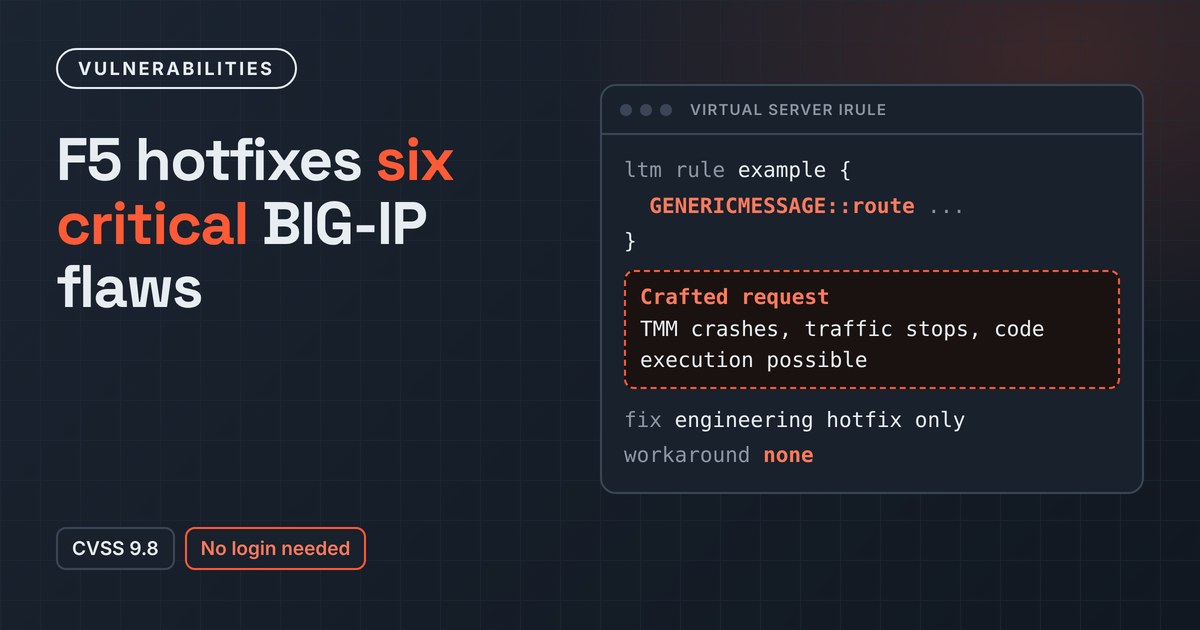
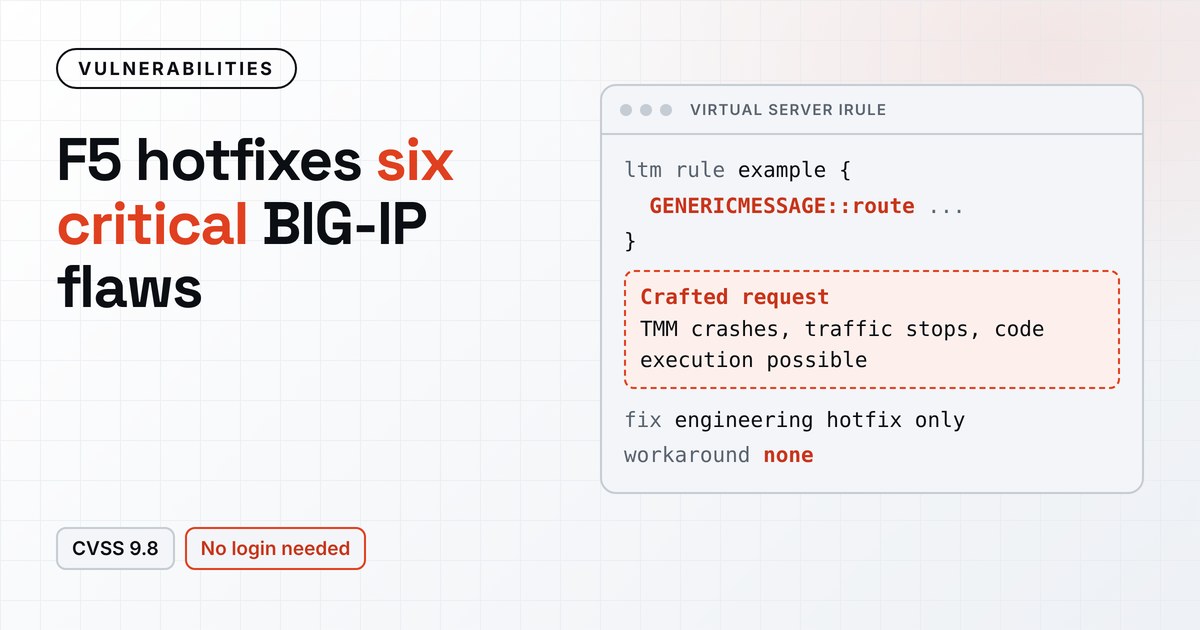
F5 has released engineering hotfixes for six critical vulnerabilities in BIG-IP, its widely used load balancer and application gateway. Each lets someone who can reach an affected virtual server, without logging in, crash the Traffic Management Microkernel (TMM), the process that handles all of BIG-IP’s traffic. Every site, API and remote access portal behind it goes down until TMM restarts. F5 adds that the bugs “may lead to remote code execution”.
The fixes came in an out-of-band security notification on 18 November, outside F5’s usual quarterly schedule. F5 rates all six 9.8 out of 10 under CVSS 3.1, and 9.3 under CVSS 4.0. It says there is no workaround, and none of its advisories reports any exploitation.
Only certain configurations are exposed
Each flaw needs a particular feature to be in use on a virtual server. Five are in iRules, the scripts BIG-IP admins write to inspect and steer traffic, and are only reachable when an iRule uses one of the affected commands. The sixth is in Access Policy Manager (APM), BIG-IP’s remote access and single sign-on module.
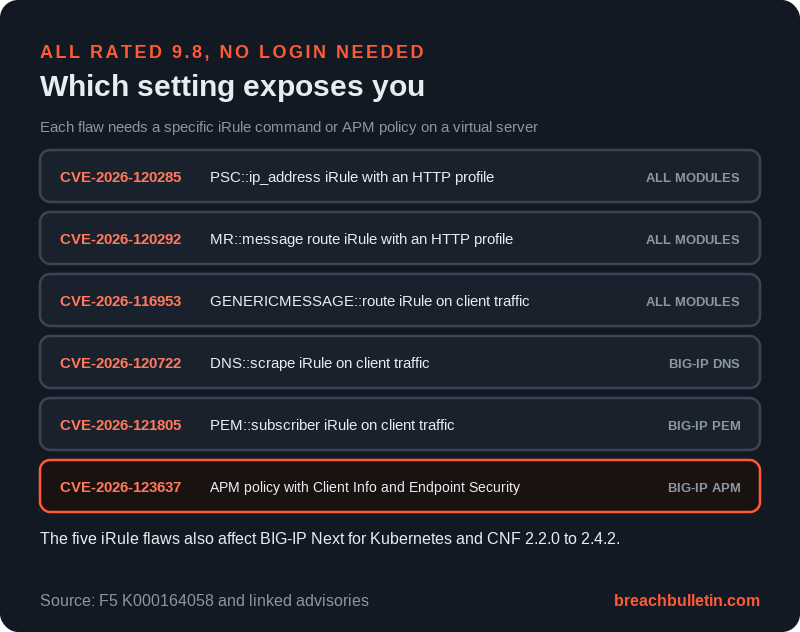
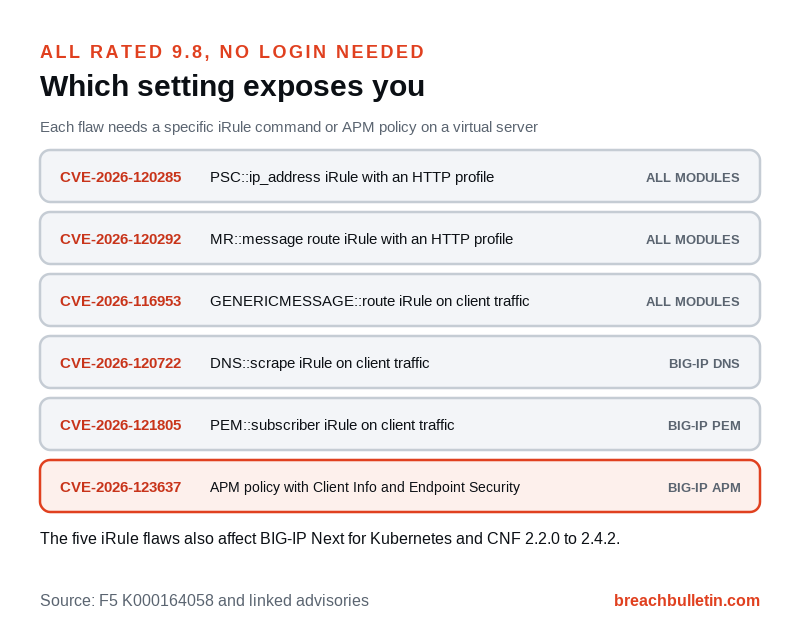
| CVE | Triggered by | Affected module | Advisory |
|---|---|---|---|
| CVE-2026-120285 | An iRule using PSC::ip_address on a virtual server with an HTTP profile |
All modules | K000163939 |
| CVE-2026-120292 | An iRule using MR::message route on a virtual server with an HTTP profile |
All modules | K000163940 |
| CVE-2026-116953 | An iRule using GENERICMESSAGE::route on client traffic |
All modules | K000163941 |
| CVE-2026-120722 | An iRule using DNS::scrape on client traffic |
BIG-IP DNS | K000163945 |
| CVE-2026-121805 | An iRule using PEM::subscriber on client traffic |
BIG-IP PEM | K000163946 |
| CVE-2026-123637 | An APM per-request policy that uses both the Client Information and Endpoint Security agents | BIG-IP APM | K000163937 |
That narrows things down. A BIG-IP that runs none of these iRule commands and no such APM policy isn’t exposed to these six, though it should still get the hotfix. F5 describes them all as data plane issues with “no control plane exposure”. So keeping the management interface off the internet, the usual advice for BIG-IP, does nothing here. The attack comes through the same virtual servers that serve your users.
Sina Kheirkhah of watchTowr reported four of the flaws: the
PSC::ip_address, MR::message route and GENERICMESSAGE::route bugs and
the APM bug. The PSC::ip_address flaw is a stack buffer overflow, according
to F5. F5 hasn’t published technical details of the others.
Versions and hotfixes
The flaws affect BIG-IP 17.1.0 to 17.1.3, 17.5.0 to 17.5.1 and 21.1.0. The five iRule flaws also affect BIG-IP Next for Kubernetes and BIG-IP CNF versions 2.2.0 to 2.2.5, 2.3.0 to 2.3.4 and 2.4.0 to 2.4.2. F5’s index from 18 November listed CNF for only some of them, but the individual advisories now include CNF for all five.
The fixes are engineering hotfixes, not regular releases, and each one is built for a specific base version. F5’s hotfix guide says which to install:
| If you run | Install |
|---|---|
| 17.1.3.7 or an earlier base release | Hotfix-BIGIP-17.1.3.7.0.21.4-ENG |
| Engineering build BIGIP-17.1.3.6.0.9.20-ENG | Hotfix-BIGIP-17.1.3.6.0.14.20-ENG |
| 17.5.1.11 or an earlier base release | Hotfix-BIGIP-17.5.1.11.0.61.12-ENG |
| Engineering build BIGIP-17.5.1.10.0.7.35-ENG or 17.5.1.10.0.37.35-ENG | Hotfix-BIGIP-17.5.1.10.0.80.35-ENG |
| 21.1.0.4 or an earlier base release | Hotfix-BIGIP-21.1.0.4.0.19.3-ENG |
| BIG-IP Next for Kubernetes or CNF 2.2, 2.3 or 2.4 | 2.2.5-EHF1, 2.3.4-EHF1 or 2.4.2-EHF1 |
If you already run a custom engineering hotfix that isn’t listed, F5 says to contact its support team for a new build.
The rest of the notification
The same notification covers 16 more advisories. Four more APM bugs, rated 7.5, can also crash TMM without a login, in setups such as SAML service providers and form-based logon pages (CVE-2026-126822 is one). In CVE-2026-125274 (8.8), an iControl SOAP user with only Guest access can inject management requests, and CVE-2026-120718 (8.1) lets a stolen iControl REST token stay valid longer than it should. The other ten are NGINX flaws, including the HTTP/2 overflow known as nginx2root that we covered in our Synology article.
Why it’s worth moving quickly
BIG-IP devices sit in front of banking portals, VPN gateways and internal applications, so a crash with no login needed is a ready-made way to take services offline. Attackers also watch F5 closely. CISA has added two BIG-IP flaws to its Known Exploited Vulnerabilities catalogue this year, most recently an APM buffer overflow, CVE-2026-94127, in September.
watchTowr often publishes technical write-ups of the bugs it reports, which would make these easier to reproduce. And F5’s own warning that code execution may be possible is reason enough not to treat them as simple outages.
Steps for BIG-IP admins
- Check whether your iRules use any of the five commands. Searching the
configuration for
PSC::ip_address,MR::message,GENERICMESSAGE::route,DNS::scrapeandPEM::subscriberis a quick start. On APM, look for per-request policies that use both the Client Information and Endpoint Security agents. - Record the exact build you run, including any engineering hotfix, with
tmsh show sys version. Use it to pick the right hotfix from F5’s guide. - Install the hotfix on internet-facing devices first, then on those carrying critical services. Test it outside production if you can.
- After installing, check that real user traffic works: open the sites and remote access portals the device serves. A working management login doesn’t show that TMM is handling traffic.
- Keep an eye on TMM restarts and core files in
/var/log/ltmand/var/core. A run of unexplained TMM crashes on an unpatched device may be someone testing these bugs. - Update Next for Kubernetes and CNF deployments to the EHF1 builds.
For F5’s statement on Java4Shell across its products, see our Java4Shell vendor table.