The 9.8 OpenSSL Base64 bug that OpenSSL itself rates Low
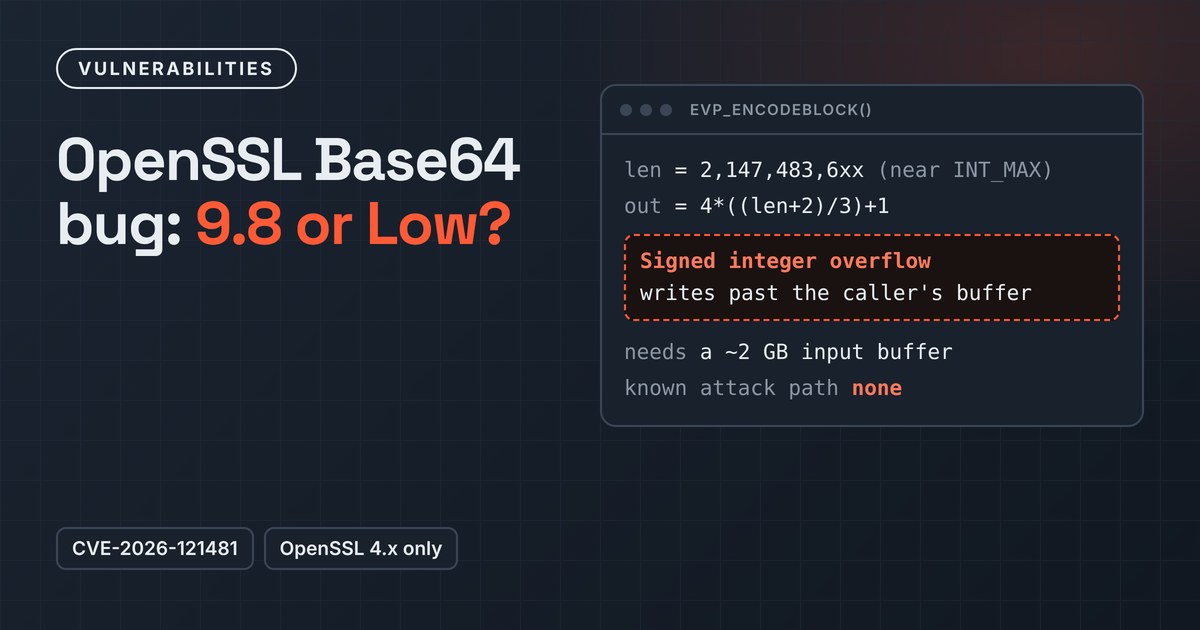
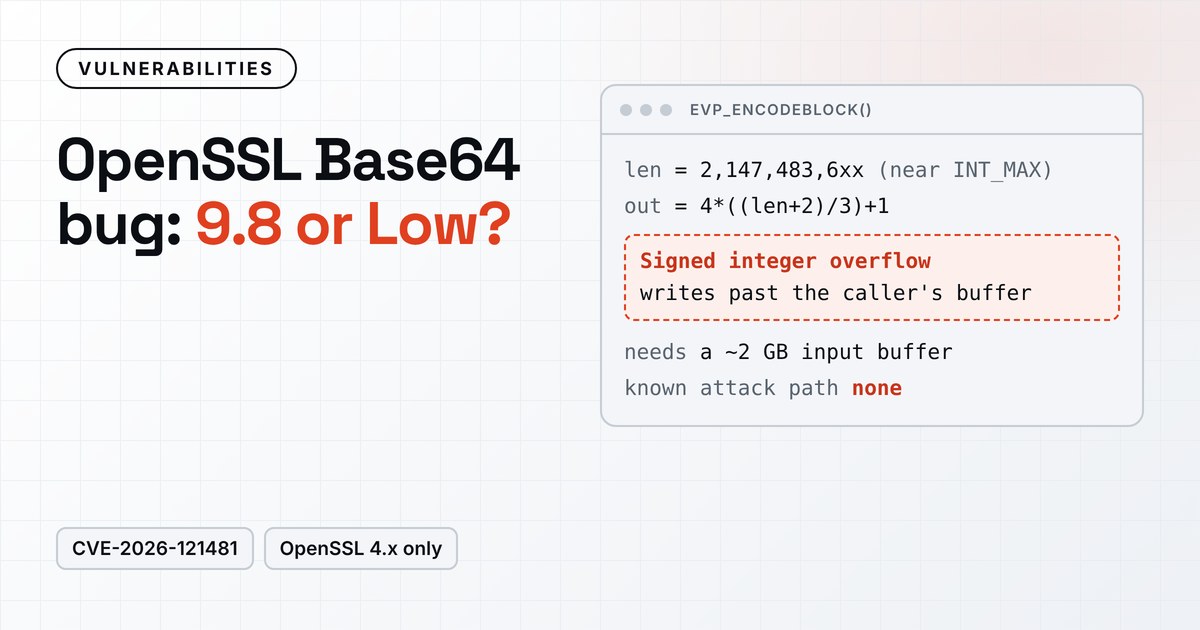
If a vulnerability scanner has just shown you a 9.8 for OpenSSL, read the details before you start an emergency patch. CVE-2026-121481 is a real bug in OpenSSL 4.x, but OpenSSL rates it Low, and says it knows of no way for an attacker to trigger it.
The bug
EVP_EncodeBlock() converts a buffer to Base64. The caller allocates the
output buffer, sized from the input length. According to OpenSSL’s
CVE record, published on
18 November, the arithmetic that works out the encoded length overflows a
signed integer when the input length is close to INT_MAX, about 2.1 billion
bytes. The function then writes more than the caller reserved, overflowing a
heap buffer.
Only OpenSSL 4.0.0 to 4.0.3 and 4.1.0 are affected. The 3.x, 1.1.1 and older branches aren’t listed. Nicky Mouha reported the bug and wrote the fix.
Why OpenSSL says Low
OpenSSL says it has found “no path by which an attacker can trigger this”. Its
own TLS, QUIC and CMS code never encodes buffers that large, and the command
line tools can’t practically be made to. To be exposed, an application has to
accept an input length from an attacker and pass it to EVP_EncodeBlock()
without checking it, and it has to be holding a buffer of around 2 GB when it
does. The affected code is outside the FIPS module.
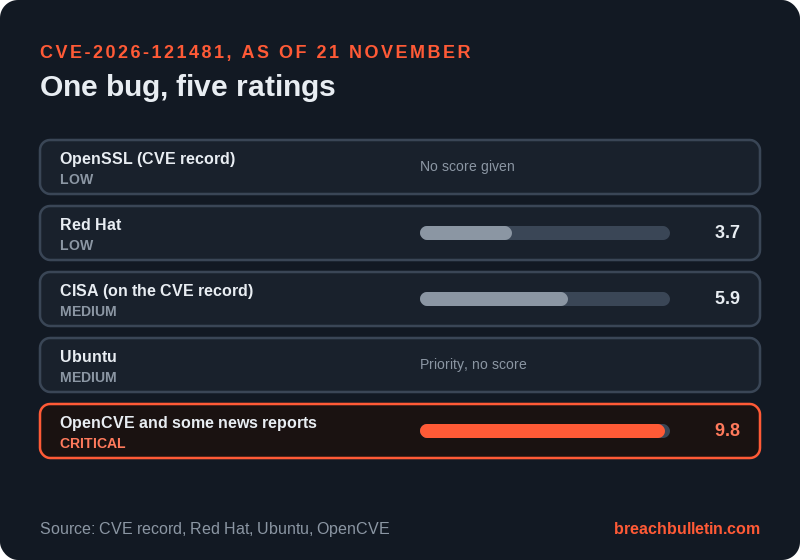
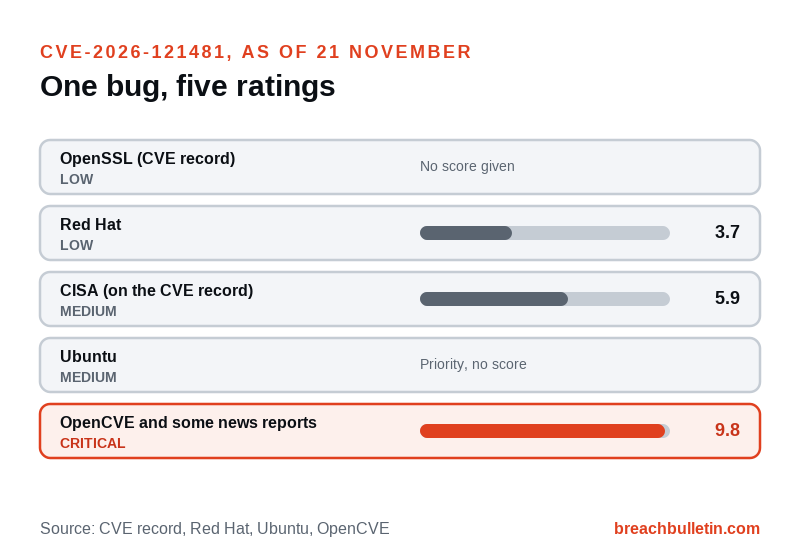
Other ratings vary widely. Red Hat also rates it Low, with a CVSS score of 3.7, and says RHEL’s own OpenSSL packages aren’t affected. CISA’s addition to the CVE record scores it 5.9 and records no exploitation. Ubuntu gives it Medium priority. The 9.8 comes from the vulnerability tracker OpenCVE, which switched to that score on 21 November, and from news reports that repeated it. That score assumes anyone on the network can trigger the bug easily and take over the system, and neither OpenSSL nor CISA says that. NVD hasn’t done its own analysis yet.
Fixes aren’t out yet
Some reports say the bug is fixed in OpenSSL 4.0.4 and 4.1.1. Those are the first versions that won’t be affected, but neither had been released when we checked on 21 November. The fix is still an open pull request on GitHub. OpenSSL’s advisory of 17 November for three other Low-rated bugs says the next releases are scheduled for 1 December.
Bundled copies and Node.js
OpenSSL is often bundled inside other software, where system updates don’t
reach it. Ubuntu’s tracker marks the Node.js package in Ubuntu 22.04 LTS as
vulnerable, because Node.js there carries its own OpenSSL. That one looks odd,
though. Ubuntu’s own note says that copy is OpenSSL 1.1.1m, a version outside
the affected range in OpenSSL’s record. Ubuntu still lists its main openssl
packages as needing evaluation.
This bug has no connection to Java4Shell, which is also a Base64 memory bug but sits in Java’s decoder, can be reached without a login in common applications, and is being probed by attackers.
What to do
- Find out whether you run OpenSSL 4.x anywhere. Most Linux distributions
still ship 3.x, so check containers, bundled runtimes and software you
built yourself.
openssl versionshows the system copy only. - If you maintain code that calls
EVP_EncodeBlock(), make sure it rejects input lengths anywhere near 2 GB before calling it. That closes the hole without waiting for a release. - Plan to install OpenSSL 4.0.4 or 4.1.1, or your distribution’s fixed package, once they’re out, and restart the services that use it.
- Treat it as routine maintenance unless your own application passes attacker-controlled lengths to the function.
For a comparison, the two Splunk Enterprise flaws in our November patch round-up need no login and work on standard setups, which is what a high score should mean.