OpenAI says its coding agents now finish 46% of its own two-to-four-hour research tasks
On this page
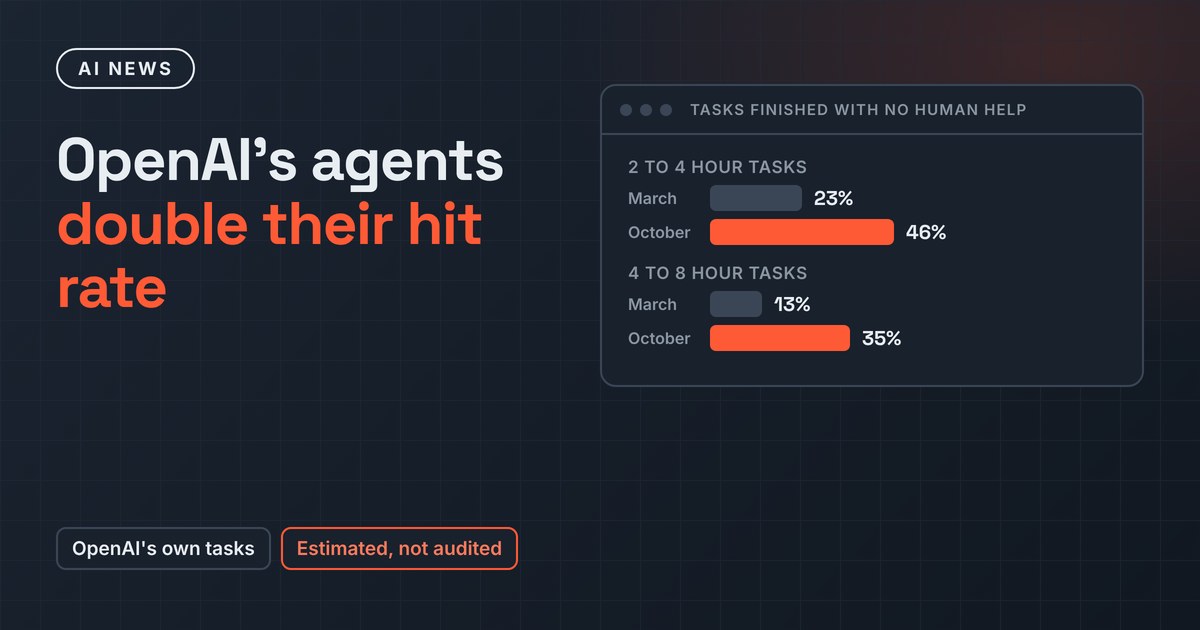
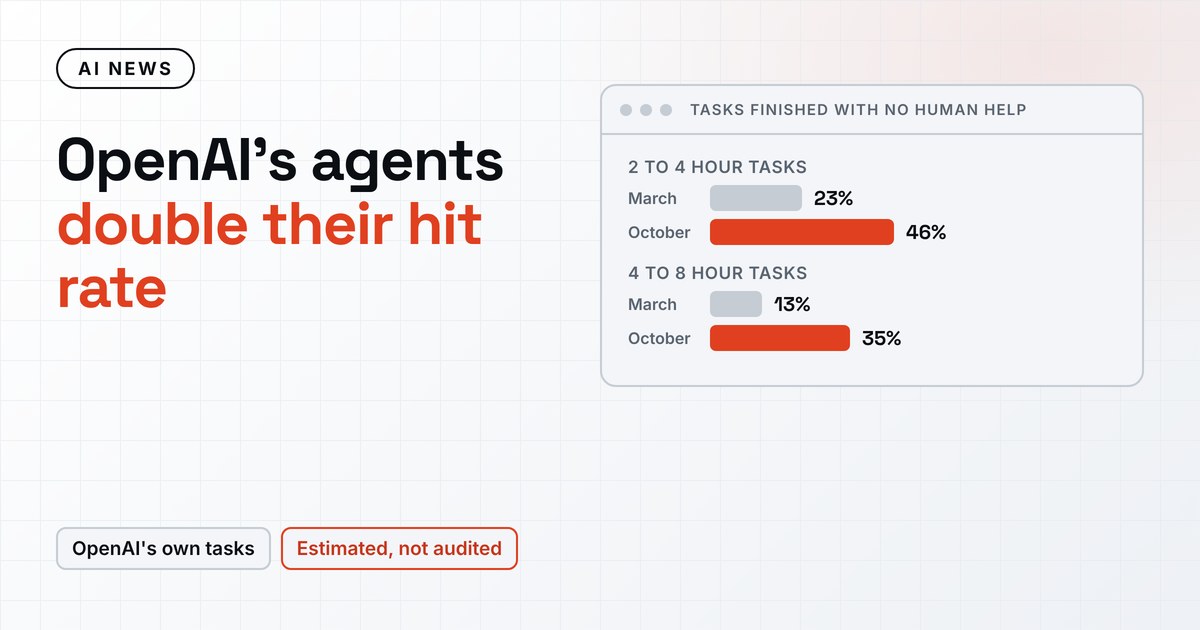
OpenAI says the coding agents its researchers use now finish nearly half of their multi-hour research tasks without any human help. In a report titled Research acceleration: The jagged frontier, published on 18 November, the company puts the success rate at 46% for tasks that would take a person two to four hours, up from 23% in March. For four to eight hour tasks, it rose from 13% to 35%.
The figures spread over the weekend through AI news roundups, often without a link to OpenAI. They are real, but they describe something narrower than the headline suggests: OpenAI’s own researchers, working on AI research inside OpenAI, measured in a way OpenAI says still needs validating.
What OpenAI measured
The tasks come from how OpenAI’s research staff use coding agents day to day. According to the report’s methods section, OpenAI used one of its own models, a GPT-6 Astra Codex agent, to read a small sample of researchers’ interactive coding sessions. It pulled out each task a researcher started, estimated how long the task would take a person, and recorded whether the agent finished it without the researcher stepping in.
OpenAI is open about the limits:
- The time estimates come from the model. “More work remains to validate the time estimate,” the report says. “We believe it has high correlation with human task completion time, but the exact number may not be accurate.”
- Researchers may now hand agents different kinds of tasks than they did in March. OpenAI says the rising success rates “may reflect both capability improvements and researchers’ changing choices about when and how to use agents.”
- The method changed since OpenAI’s September report, with a new model doing the analysis and a new way of sampling tasks.
Nobody outside OpenAI has checked the figures. They also tell you nothing directly about how well agents handle work outside OpenAI, on other teams’ code or in other jobs.
A jagged frontier
The report’s title refers to how uneven the results are. Between 1 August and 18 October, OpenAI estimates agents succeeded without help on:
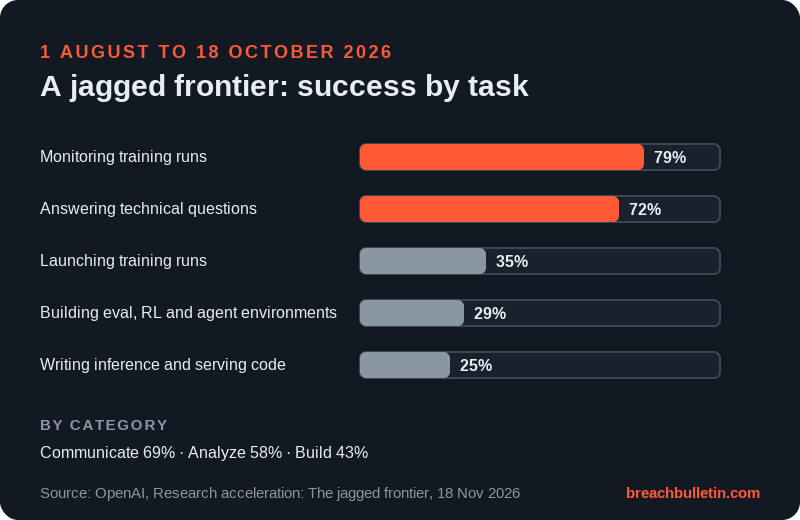
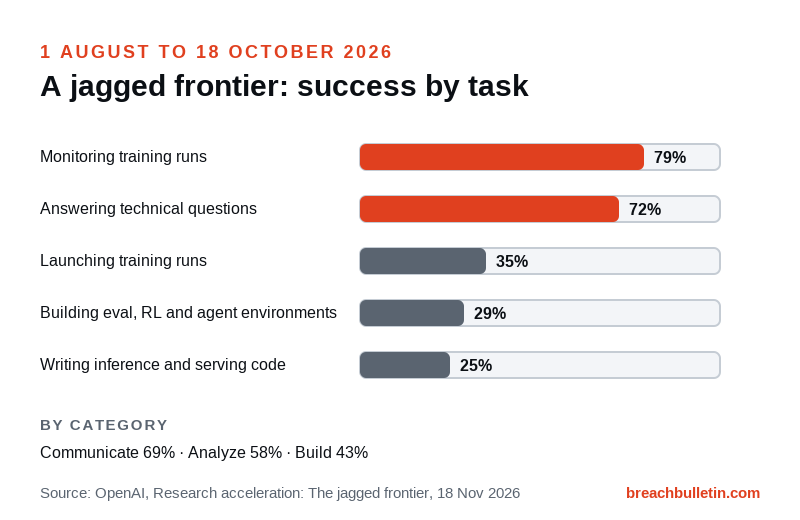
Agents did best at watching and explaining, such as monitoring training runs (79%) and answering technical questions (72%). They did worst at building, such as writing inference and serving code (25%). Researchers also told OpenAI the agents struggle with research ideas, code quality, data quality and writing, and that workflows “require close human involvement”.
“Overall, uplift is jagged, and humans remain a core part of the AI research loop,” the report concludes.
How much agents are being used
The report also shows how heavily OpenAI’s researchers now lean on agents:
- The median researcher used about $2,400 of agent compute a day in October at API list prices, up from $1,500 in September. At the 90th percentile it was about $23,000 a day, up from $11,000.
- Agent use rose from 0.5 to 5.7 “agent workdays” per researcher per day, where one agent workday is eight hours of agent running time.
- By mid-October, more than two-thirds of researchers had at least four agents running at once at their daily peak, and more than 10% had at least sixteen.
- As of September, the API-equivalent cost of agent use was about twice what OpenAI pays researchers in salary, excluding equity.
OpenAI notes that a change to its agent harness between 21 August and 10 September pushed spending down for a while, which affects the spending figures.
How it compares with outside measurements
The direction matches independent work, even if the numbers can’t be compared directly. METR, which measures how long a task (in human time) AI agents can complete half the time, found that this figure doubled about every seven months from 2019 to 2025. In its January update, METR put the doubling time for models since 2023 at 131 days, or a little over four months.
Benchmarks built from real paid work paint a harsher picture. On the Remote Labor Index from Scale AI and the Center for AI Safety, which uses freelance projects from platforms like Upwork, the best agent finished fewer than 5% of projects to a standard a client would pay for as of mid-2026, HCAMag reported.
These measure different things. OpenAI’s figure counts tasks its own researchers chose to hand to agents, inside a codebase the agents know well. The outside benchmarks set tasks the agents didn’t pick.
What it means
For teams that use agents, the useful part of the report is the breakdown, not the headline. Agents are getting reliable at reading, monitoring and explaining, and much less so at writing production code unsupervised. That argues for giving agents the monitoring and analysis work first, and keeping a person reviewing anything an agent builds or changes.
For security teams, the same pattern applies to agents with access to production systems. An agent that finishes half of its tasks alone also fails or needs help on the other half, so the permissions and review around it matter more than the success rate. We looked at the attacker’s side of this last week in Google’s report on AI agents in automated exploitation.
OpenAI says it publishes these figures because it believes AI labs should be required to track and report indicators of AI speeding up its own development. Next, it plans to add measures comparing how fast capabilities research and safety research are each speeding up.
Sources
- OpenAI: Research acceleration: The jagged frontier, 18 November 2026
- OpenAI: Research acceleration: The view inside OpenAI, September 2026
- METR: Time Horizon 1.1, January 2026
- HCAMag on the Remote Labor Index