Robotics funding heads for $60.7 billion this year as listed robotics stocks fall
Private investors are pouring money into robotics at a record pace, while public investors are marking robotics shares down. Both trends come from the same report: venture firm F-Prime Capital’s State of Robotics, which it presented at the RoboBusiness conference and published on 27 October.
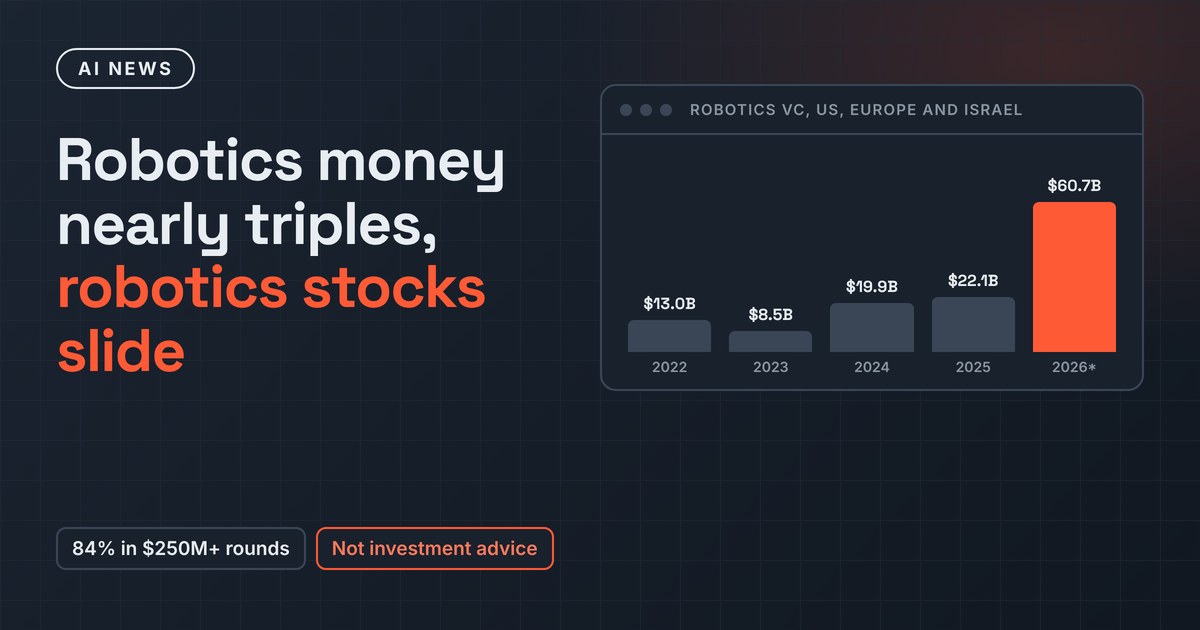
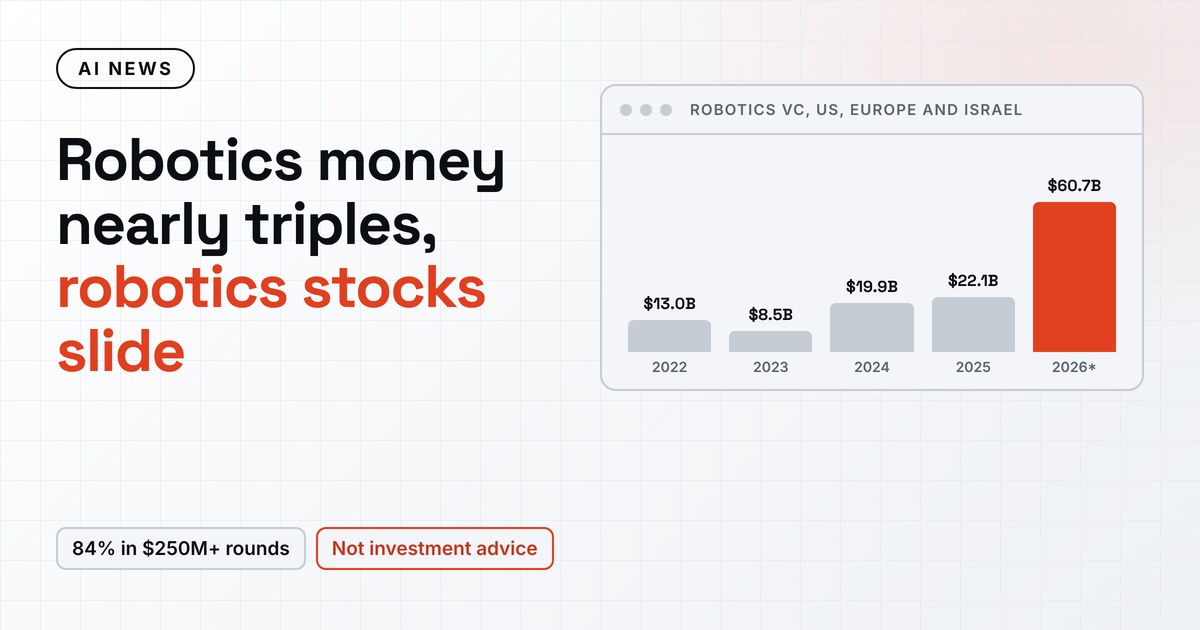
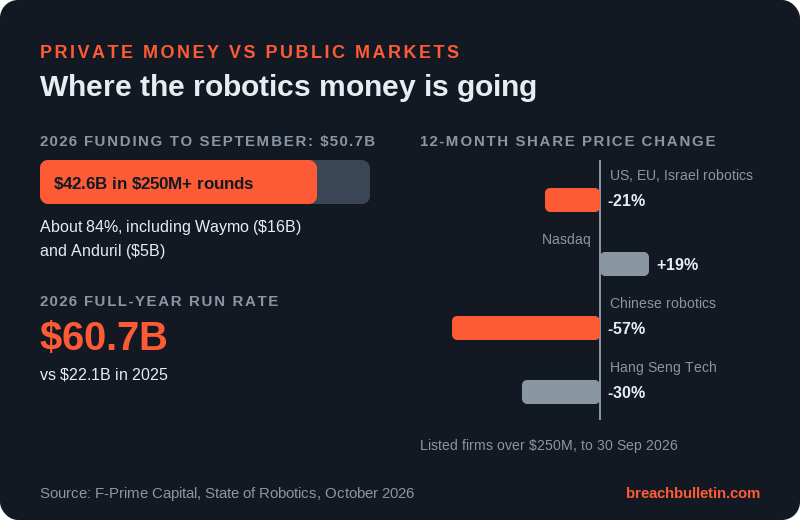
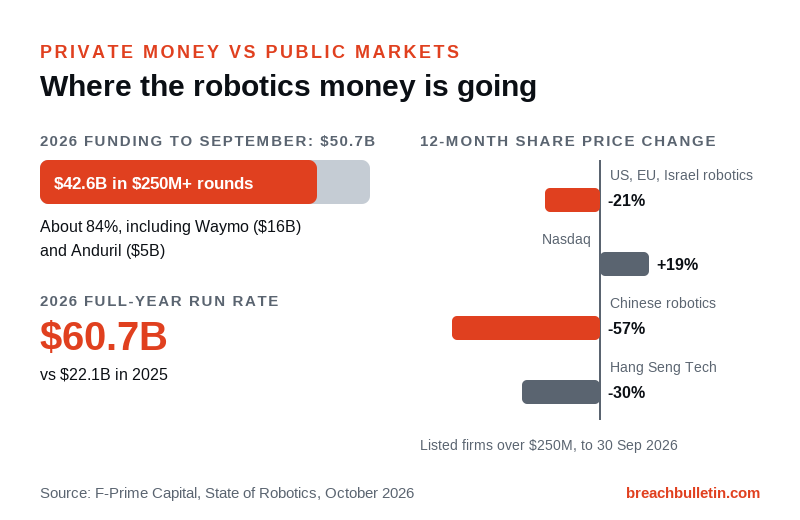
F-Prime expects robotics companies in the US, Europe and Israel to raise $60.7 billion in 2026, close to what they raised in the previous four years combined. In 2025 they raised $22.1 billion. Robotics & Automation News reported the figures on 22 November.
This is about markets, not cybersecurity, and none of it is investment advice.
What the figures cover
The $60.7 billion is a full-year run rate, not money already raised. By the end of September, robotics companies had raised about $50.7 billion, according to F-Prime’s data from PitchBook. F-Prime projected the rest of the year from that, leaving out two exceptional deals: Waymo’s $16 billion round and Anduril’s $5 billion round.
The report counts only companies in the Americas, Europe and Israel, with about 80% of the money going to the Americas. Chinese robotics companies, which make most of today’s humanoid robots, aren’t in the total.
Other trackers count differently and get different answers. ABI Research, for example, counted $34.1 billion between January and early September and expects the year to close above $40 billion. Startup data firm Dealroom, quoted by Hannover Messe, had $55.8 billion raised by early June.
A few very large rounds
F-Prime says “nearly all the investment gains are from mega rounds” of $250 million or more. Through September there were 25 of them, worth $21.6 billion, on top of the Waymo and Anduril deals. Together that is about $42.6 billion, or roughly 84% of the money raised.
By segment, F-Prime’s 2026 run rates are:
- $25.2 billion for vertical robotics, such as logistics, medical, defence, manufacturing and construction robots
- $18.7 billion for autonomous vehicles, not counting Waymo’s round
- $9.9 billion for general-purpose robotics, meaning humanoids and robot foundation models, up from $6.2 billion in 2025
Public markets disagree
Listed robotics companies have not shared the excitement. Across companies in the Americas, Europe and Israel worth more than $250 million, share prices fell 21% on average in the 12 months to 30 September, while the Nasdaq rose 19%, according to F-Prime. Chinese listed robotics companies fell 57% on average, against a 30% fall in Hong Kong’s Hang Seng Tech index.
The stock market has been rough on AI more broadly this month. Last week we covered the worst week for AI stocks since March 2020.
F-Prime itself sounds a note of caution. It says acquisitions are only “slowly recovering” as a way for investors to cash out, and that SPACs, the listed shell companies that boomed in 2021, are back. Its message to founders ends bluntly: “Revenue is the gravity of start-ups. Today’s overpriced rounds will come down to earth, eventually.”
Sources
- F-Prime Capital: State of Robotics, RoboBusiness 2026, 27 October 2026 (report slides linked from the page)
- Robotics & Automation News, 22 November 2026
- ABI Research: Robotics Investment Monitor 2026
- Hannover Messe: Robotics is rolling in money, citing Dealroom