Wiz: attackers used AI tools to take over Kubernetes clusters and steal cloud keys
Attackers using AI attack frameworks have been taking over Kubernetes clusters and walking off with cloud credentials, often within a few days of getting in, according to Wiz Research. Wiz published its findings on 23 November, covering activity from late October to mid-November.
The tools named include ARTEX, an open-source AI penetration-testing framework, and CyberStrikeAI. The weaknesses they used are familiar ones: stolen tokens, CI jobs that are trusted too much and service accounts with too many rights. The tools chained them together fast.
ARTEX-Harvester
Wiz calls one cluster of activity ARTEX-Harvester and says it’s one of about a dozen campaigns it’s tracking. It links Harvester, at varying confidence, to more than a dozen organisations. The attacker sent requests through a different residential or ISP proxy almost every time, using more than 220 IP addresses against a single target.
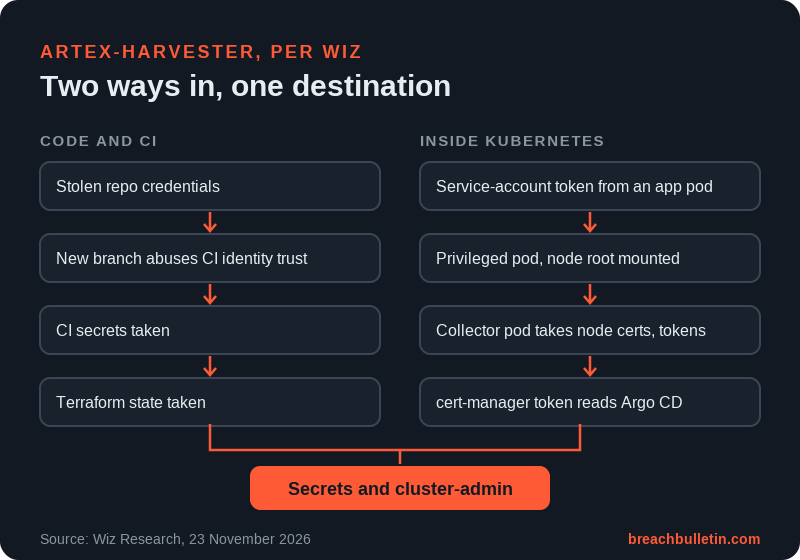
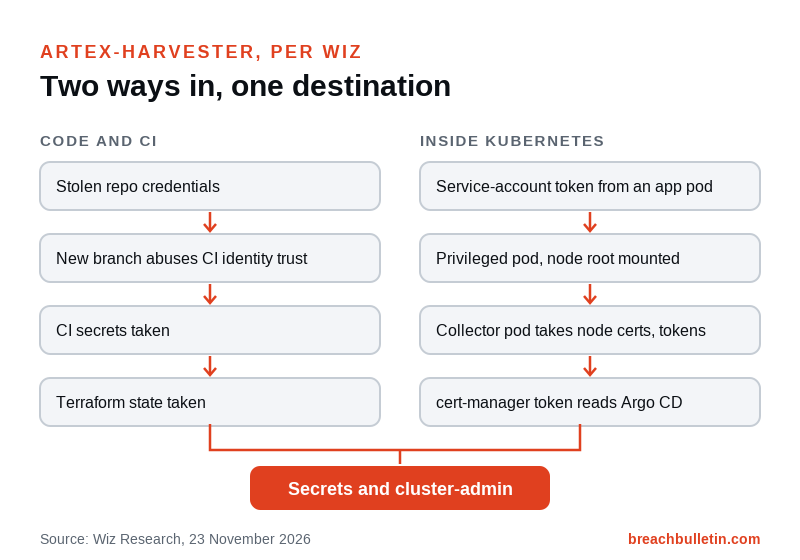
Wiz describes two routes in. In the first, stolen version-control credentials opened private repositories. The attacker created branches that abused the trust cloud providers give to CI workload identities, then took CI secrets and Terraform state.
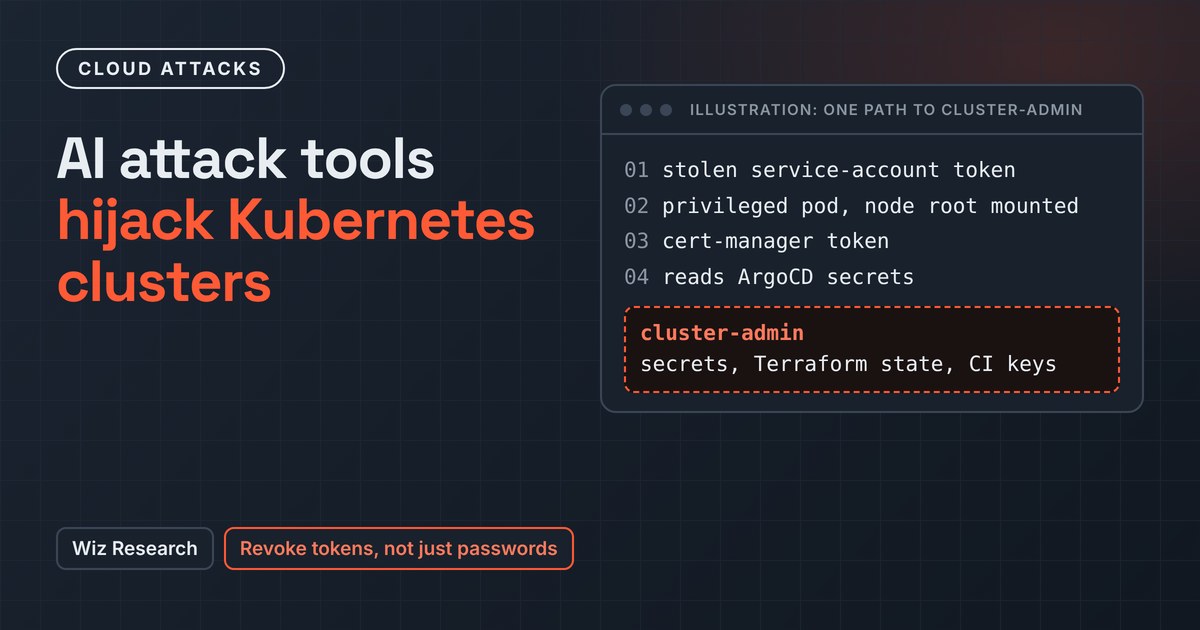
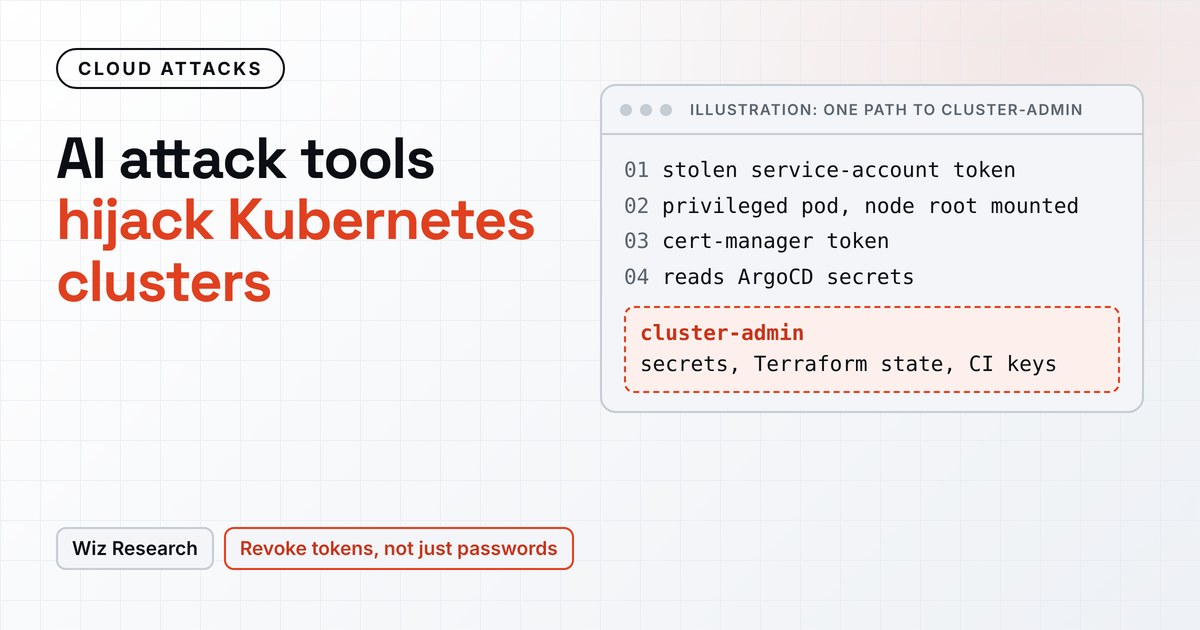
The second ran inside Kubernetes. A service-account token stolen from an application pod was used to create privileged pods with the node’s root filesystem mounted. A “node-level collector” pod gathered kubelet certificates and service-account tokens. One of those, a cert-manager token, could read Argo CD secrets, and that led to cluster-admin.
Four days, seven clusters
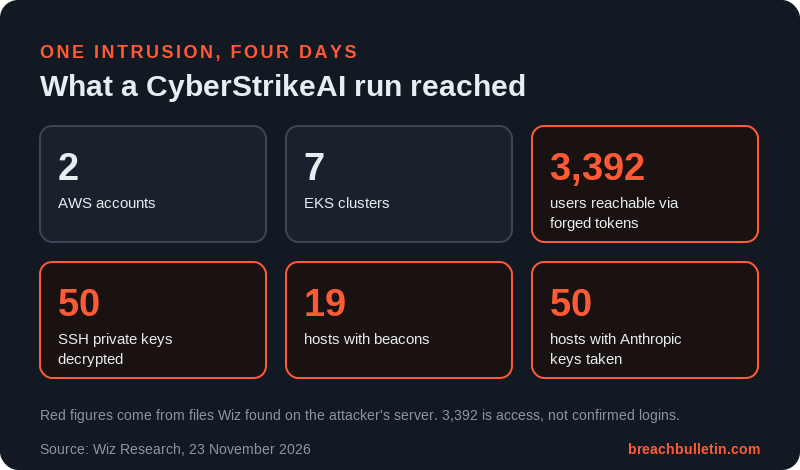
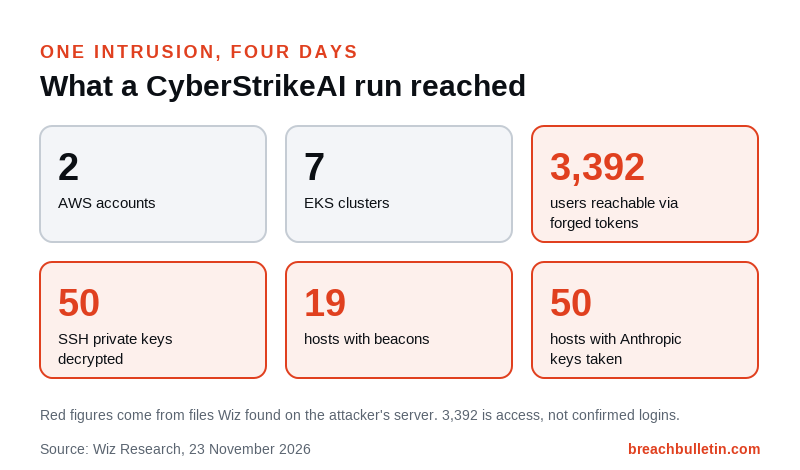
Wiz also walks through a separate, anonymised case from October that it says CyberStrikeAI ran, based on a “csai-” prefix on the resources it created. In four days the attacker spread across two AWS accounts and seven Amazon EKS clusters.
It started with a stolen session from a Terraform runner, which the attacker used to read the kubelet’s kubeconfig, create a privileged pod and bind itself to cluster-admin. It then got remote code execution on the Jenkins controller, escaped a pod onto a node and planted a rootkit. Node, IRSA and Terraform runner credentials were then used from the attacker’s own server to read Terraform state and AWS Secrets Manager and to open SSM sessions.
Files on the attacker’s server showed how far it got:
- forged admin tokens that gave access to 3,392 identity-provider users and their live session tokens (that’s access, not 3,392 confirmed logins)
- 50 SSH private keys, decrypted from a bastion host’s database
- beacons pushed to 19 hosts
- GitHub Actions secrets dumped
- the production Jenkinsfile changed so the job ran before its approval step, exposing production secrets
- Anthropic API keys taken from 50 hosts
- AI coding assistant session histories searched for production SSO credentials
The rootkit hooked into processes through ld.so.preload, called home over a
DNS tunnel and posed as a fontconfig service. Wiz says it had no detections on
VirusTotal.
A wider rise
Internet scanning firm Censys counted 1,465 hosts running an exposed ARTEX console in early November. That isn’t 1,465 attackers: about 650 of them sit in two blocks of identically set-up hosting, and Censys thinks some belong to legitimate testers.
Wiz says publicly disclosed incidents have more than tripled since its Black October post, with 20 more in three weeks, and its incident response team has seen three times as many requests for help.
Wiz is careful about attribution. ARTEX has hundreds of forks and many unrelated users, so seeing it in an attack doesn’t tell you who’s behind it. Wiz names Storm-0940, which it describes as China-state aligned, as one earlier ARTEX user, but says there isn’t enough detail to tie all these incidents to one actor or tool.
We’ve covered ARTEX twice already, in Barracuda’s cloud breach and Google’s warning on automated exploitation. The European Commission has also confirmed an AI-assisted attack in October. Politico reported that ARTEX was involved, but the Commission hasn’t named the tool, and Wiz’s report doesn’t mention that attack.
What to check
Wiz published around 70 IP addresses and an IOC file for this activity. It warns that its detections are perishable, because the tools change fast. It doesn’t give a step-by-step fix list, so these steps are our own, based on what the attackers did:
- Use short-lived credentials for CI, Terraform runners and workloads. Scope CI identity trust to specific repositories and branches, so a new branch can’t pick up production rights.
- Block privileged pods and host filesystem mounts with Pod Security Admission or an admission controller, except in namespaces that truly need them.
- Check what cert-manager and Argo CD can read. Neither should see secrets across the whole cluster unless it has to.
- Alert on bulk secret reads, cloud or workload credentials used from outside
your environment, new privileged pods and new cluster-admin bindings. Wiz
also flags resource names with tool prefixes such as “csai-” and user
agents such as
pentest-recon. - If you’re hit, revoke rather than reset. Kill live sessions and replace SSH keys, API keys (AI provider keys included), CI secrets and service-account tokens. A password reset leaves stolen session tokens working.
Sources
- Wiz Research: Agentic Attacks in the Wild, 23 November 2026
- Wiz Research IOCs on GitHub
- Censys: ARTEX, Agentic Asbestos, 5 November 2026
- The Record: European Commission confirms cyberattack, says hackers used AI tool
- GBHackers and Cyber Security News, 24 November 2026